World Cup 2026 Betting
Argentina at the 2026 World Cup — Group J Odds & Title Defence
 Available in US
Loading...
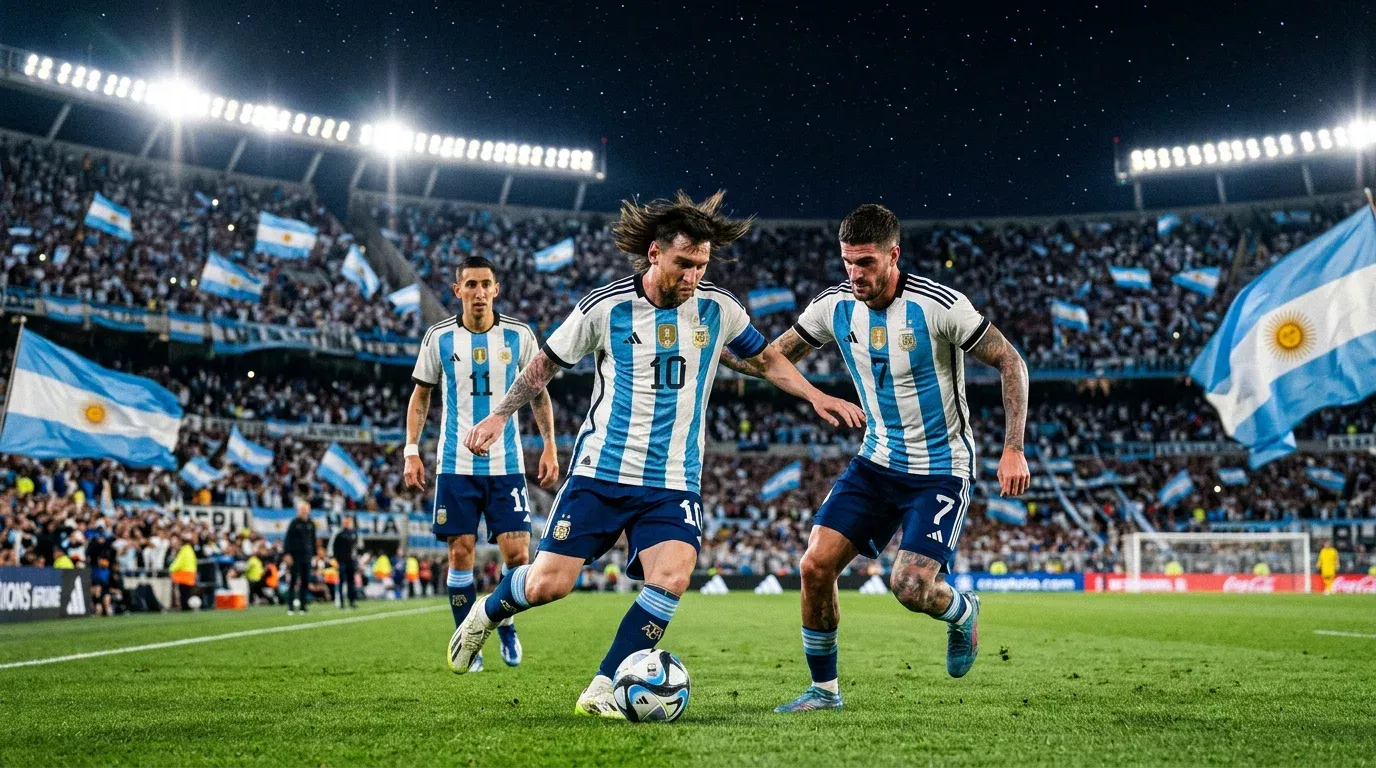
The image remains frozen in collective memory: Lionel Messi lifting the World Cup trophy in Lusail, finally completing the one achievement that had eluded the greatest player of his generation. I watched that final against France with a room full of analysts who had spent careers debating whether Messi could reach Maradona’s 1986 heights without World Cup validation. The debate ended that December night in Qatar. Now Argentina enters the 2026 World Cup as defending champions, a status that transforms every tactical decision, every squad selection, and every betting market into a referendum on whether lightning strikes twice.
Group J places Argentina alongside Algeria, Austria, and Jordan — a draw that should produce comfortable advancement without the stress that Group L or Group K opponents would generate. The real questions surround squad evolution, the post-Messi transition that everyone discusses but nobody wants to confront directly, and whether the winning mentality cultivated under Lionel Scaloni can persist as the core ages and new faces emerge. For bettors evaluating Argentina’s 2026 prospects, understanding both the structural advantages of defending champion status and the historical challenges of title defense will separate informed wagers from nostalgia-driven positions.
The Weight of the Crown — Defending Champion Dynamics
Only two nations have successfully defended World Cup titles in the modern era: Italy in 1934-1938 and Brazil in 1958-1962. France fell to a group stage exit in 2002 after winning in 1998. Spain crashed out in the group stage in 2014 following their 2010 triumph. Germany managed a respectable quarterfinal in 2018 before suffering group stage elimination after their 2014 victory in Brazil. The historical pattern suggests that defending champions face unique psychological and tactical challenges that simple talent evaluation cannot capture.
Argentina enters 2026 with awareness of these precedents. Scaloni’s coaching staff has studied the failures of previous defending champions, identifying complacency, tactical stagnation, and squad aging as the primary causes of disappointing defenses. The response has involved controlled squad turnover, introducing younger players into the system while maintaining the core that delivered in Qatar. Whether this approach succeeds where France, Spain, and Germany failed remains the central uncertainty in Argentina’s tournament projection.
The target on Argentina’s back changes opponent preparation entirely. Every team in Group J will treat their Argentina match as the defining moment of their tournament — Algeria will play for national pride and Arab world recognition, Austria will see an opportunity to announce their arrival among European contenders, and Jordan will approach the match as a historic occasion regardless of result. This concentrated opponent motivation creates challenges that non-defending champions do not face, where every match carries elimination-level intensity even when the stakes technically do not require it.
Market pricing reflects defending champion status without fully accounting for the historical failure rate. Argentina trades as co-favorite alongside Brazil and France, with outright odds between 5.50 and 7.50 depending on the sportsbook. These prices assume successful navigation of challenges that have eliminated every defending champion since Brazil’s 1962 retention. I find the market slightly optimistic given the historical base rates, though Argentina’s specific squad quality and tactical continuity justify pricing among favorites.
CONMEBOL Qualification Recap
South American qualification tested Argentina’s champion credentials across 18 matches spanning three years. The campaign produced expected results: Argentina finished atop the CONMEBOL standings with a point total that reflected dominance over regional rivals. Brazil pushed throughout the qualification cycle, but Argentina’s consistency in extracting results from difficult away fixtures maintained separation at the top of the table.
The coaching staff used qualification intelligently, balancing result accumulation with squad development. Younger players received minutes in matches where established starters could rest, building familiarity with the tactical system and international intensity without risking qualification position. By the campaign’s conclusion, Argentina had identified backup options at every position — a depth advantage that will prove crucial across a 48-team tournament’s extended match schedule.
Away fixtures in Bolivia’s altitude and Colombia’s humidity produced the character-testing moments that reveal championship quality. Argentina secured results in both environments, demonstrating adaptability that European teams cannot replicate through their qualification format. The CONMEBOL gauntlet provides preparation for tournament challenges that UEFA’s seeded groups cannot match — a structural advantage that persists into the World Cup itself.
Tactical evolution continued throughout qualification as Scaloni refined the system that delivered the 2022 trophy. The 4-3-3 base remains, but positional flexibility has increased, with players comfortable rotating between roles depending on opponent structure and match state. This adaptability proved decisive in Qatar and should provide similar advantages in North American venues where opponent quality varies significantly across group and knockout stages.
Group J — Algeria, Austria and Jordan
The Group J draw gave Argentina the comfortable path that defending champions require. Algeria represents the most credible threat — African champions with technical midfielders and a diaspora support base that will fill North American stadiums with passionate backing. Austria brings European tactical discipline and Bundesliga-quality players who can compete physically if not technically. Jordan completes the group as the clear underdog, their qualification a triumph of development that exceeds realistic knockout ambitions.
Algeria’s presence creates the most interesting Group J dynamic. The Fennec Foxes qualified through CAF with performances that demonstrated improved squad depth compared to their 2014 World Cup appearance. Riyad Mahrez may have aged past his Manchester City peak, but the supporting cast has developed through European leagues and African club football. Algeria will approach the Argentina match with the fervor of an entire continent’s hopes — the Arab and African football worlds watching for a statement result against the defending champions. The passionate Algerian diaspora in France and North America ensures stadium atmospheres will feel nearly like home fixtures for Algeria, creating crowd dynamics that Argentina must prepare for tactically and psychologically.
Austria operates in a tier between genuine contenders and comfortable qualifiers. Their UEFA Nations League performances demonstrated capability against mid-ranking European opponents, but the step up to World Cup knockout intensity remains unproven. David Alaba’s defensive leadership and Marko Arnautović’s physical presence provide quality at both ends, though overall squad depth cannot match Argentina’s options. The match should favor Argentina clearly, but Austria’s organization could produce a frustrating tactical battle if Scaloni’s team lacks patience.
Jordan represents the heartwarming underdog story without realistic upset potential. Their qualification through AFC reflects improved infrastructure and developmental investment, but the gap between Jordan’s best players and Argentina’s rotation options spans multiple quality tiers. This match should produce Argentina’s largest victory margin of the group stage, providing goal difference advantages that may matter for knockout seeding. The coaching staff will likely use this fixture to rest key players, giving rotation options tournament minutes while maintaining tactical coherence.
My projection: Argentina wins the group with 9 points, Algeria finishes second with 4-6 points depending on results against Austria and Jordan, Austria claims third with a victory over Jordan, and Jordan exits without points. The scenario sets Argentina up for a Round of 32 match against a third-place finisher from Group I or Group K — potentially Senegal, Uzbekistan, or DR Congo, opponents who would enter as clear underdogs.
Key Players — The Post-Messi Question
Every Argentina preview must address the question directly: what happens when Messi is no longer the focal point? The 2026 World Cup will see Messi at 38 years old, an age that suggests reduced minutes, specific deployment situations, and squad dynamics that cannot revolve around a single player’s brilliance as completely as previous tournaments allowed. Scaloni has prepared for this transition, but implementation under tournament pressure differs from theoretical planning.
Julián Álvarez represents the attacking future. His Manchester City development under Pep Guardiola produced the positional intelligence and pressing intensity that modern tournament football demands. Álvarez scored in the 2022 semifinal and final, announcing himself as a player capable of decisive moments when pressure peaks. His partnership with whatever role Messi plays — starter, substitute, or symbolic captain presence — will determine Argentina’s attacking functionality.
Lautaro Martínez provides the alternative striking profile: physical presence, aerial ability, and Serie A-proven finishing that complements Álvarez’s movement and pressing. The two-striker systems that Argentina occasionally deploys allow both to feature, creating tactical flexibility that opponents must prepare for differently than single-striker approaches.
In midfield, Enzo Fernández has emerged as the orchestrator. His Chelsea struggles have not diminished the technical quality that produced the 2022 Young Player Award — international football suits his passing range and positional discipline better than Premier League chaos. Rodrigo De Paul continues to provide the defensive coverage and ball-winning that allows creative players to operate freely, while Alexis Mac Allister’s Liverpool experience adds Premier League intensity to the midfield options.
The defensive spine has aged gracefully. Nicolás Otamendi and Cristian Romero provide center back options with different profiles — Otamendi’s experience and positioning complementing Romero’s aggression and recovery pace. The fullback positions have evolved, with younger players emerging to complement or replace the 2022 starters depending on tactical requirements. Lisandro Martínez offers versatility across the back line, capable of covering center back or left back positions with equal comfort.
Emiliano Martínez anchors everything from goal. His penalty shootout heroics in 2022 created a legend that will influence opponent psychology throughout 2026. Strikers facing Martínez in knockout shootout scenarios will carry the weight of his reputation — the dancing, the timing disruption, the psychological games that have become his trademark. This intangible advantage compounds across elimination matches where shootouts become increasingly likely.
The depth behind these primary players separates Argentina from most opponents. At every position, Scaloni can call upon alternatives who would start for middle-tier World Cup nations. This depth allows tactical adjustments without quality degradation, rotation strategies that preserve energy for knockout matches, and injury insurance that smaller squads cannot replicate. The 2022 triumph demonstrated depth utilization — multiple players contributed decisive moments across the tournament, not merely the eleven starters.
Young players emerging from Argentine club football and European development pathways have integrated into the national team structure through friendly matches and qualification cycles. These players understand the tactical system, accept their current roles, and will be prepared for expanded responsibilities if injuries or form issues affect senior squad members. The generational pipeline suggests Argentina will remain competitive beyond 2026, though the immediate focus remains extracting maximum performance from the current championship core.
System and Style of Play
Scaloni’s Argentina plays with defensive pragmatism that contradicts romantic notions of South American flair. The tactical foundation prioritizes solidity — compact defensive shape, disciplined pressing triggers, and patient build-up that waits for opponent mistakes rather than forcing combinations through congested spaces. This approach won a World Cup and Copa América, validating the philosophy against critics who wanted more expressive football.
The 4-3-3 formation creates the defensive base, with Messi historically occupying a free role that defied positional classification. As Messi’s minutes decrease, the system will need adjustment — either committing to a more structured 4-3-3 with a conventional right winger, or finding another player capable of the positional freedom that Messi’s genius justified. This tactical question remains Argentina’s primary uncertainty entering the tournament.
Transition speed defines Argentina’s attacking moments. The shift from defensive shape to attacking overload happens quickly, with players conditioned to recognize triggers and execute rehearsed movements. Álvarez’s runs behind defenses initiate these transitions, while midfielders support with late arrivals into the box that opponents struggle to track. Set pieces add another dimension — Argentina’s aerial presence on corners and free kicks produces goals that tight knockout matches often require.
The defensive organization reflects lessons learned across multiple tournament cycles. Argentina concedes few goals from open play, with the central midfield providing effective screening for a back four that rarely faces sustained pressure. The fullbacks balance attacking contribution with defensive responsibility — neither ventures forward without coverage arrangements in place. This conservative approach limits spectacular attacking sequences but produces the clean sheets that knockout football rewards.
Without the ball, Argentina presses intelligently rather than intensively. The front line identifies triggers and engages selectively, forcing opponents toward areas where midfield support can recover possession. This energy conservation strategy allows Argentina to maintain tactical shape across 90 minutes without the physical decline that aggressive pressing systems often produce in second halves. Tournament football rewards this sustainability — teams that exhaust themselves in group stages lack the reserves for knockout intensity.
Defending the Title — Historical Precedent
The history of World Cup title defense reads like a cautionary tale. France 2002 stands as the most dramatic failure: the defending champions exited the group stage without scoring a goal, Zinedine Zidane injured, the supporting cast unable to replicate their 1998 magic. Spain 2014 suffered similar humiliation, the tiki-taka philosophy that had dominated world football suddenly exposed by Dutch physicality and Chilean pressing. Germany 2018 fell to South Korea in the group stage, Manuel Neuer stranded upfield as the ball rolled into an empty net.
Argentina has studied these failures. The coaching staff identified common threads: tactical stagnation, squad complacency, and physical decline among key players. The response has involved gradual squad evolution rather than wholesale changes, maintaining the winning core while introducing younger legs that preserve energy across tournament weeks. Whether this approach succeeds where previous defending champions failed will determine Scaloni’s legacy and Argentina’s historical standing.
The 2026 squad maintains continuity with 2022 while acknowledging generational transition. Most starting positions feature the same players four years older, supplemented by emerging talents who have integrated into the system through qualification matches and Copa América cycles. This balance attempts to preserve winning mentality while avoiding the staleness that doomed previous defenders.
Betting Markets — Outright and Group Odds
Argentina’s outright odds between 5.50 and 7.50 reflect defending champion status without accounting for historical failure rates. For comprehensive World Cup 2026 odds analysis, Argentina’s position among favorites appears justified by squad quality while perhaps overvaluing the defending champion narrative. The true probability of successful defense likely sits around 12-15%, making fair odds closer to 7.00-8.50 range.
Group J winner odds around 1.25 offer limited value — the prices accurately reflect Argentina’s dominance over Algeria, Austria, and Jordan without providing positive expected value opportunities. Qualification markets similarly lack actionable value, as Argentina’s advancement probability exceeds 95% and prices reflect this reality.
Player markets offer more interesting opportunities. Álvarez’s Golden Boot odds around 15.00-20.00 provide value if Argentina reaches the semifinals, where his minutes and goal involvement should accumulate. Martínez for Golden Glove trades at reasonable prices given his tournament pedigree and the likelihood that Argentina’s defensive organization limits opponent scoring opportunities.
The most interesting market involves Argentina’s exact tournament finish. Semifinal exit represents the median expectation for defending champions, and prices around 4.00-5.00 for Argentina to reach semifinals but not the final could offer value if you believe the historical pattern of title defense failure while acknowledging Argentina’s clear path through Group J and likely favorable Round of 32 opponent.
Can Argentina Repeat?
The honest assessment recognizes that consecutive World Cup triumphs represent football’s most difficult achievement. Argentina possesses the squad quality, tactical framework, and championship experience to succeed where France, Spain, and Germany failed. The question is whether those advantages overcome the psychological burden, opponent motivation increases, and historical patterns that have defeated every defending champion since 1962.
My projection: Argentina advances from Group J with 9 points and enters the knockout rounds as co-favorites alongside Brazil and France. The Round of 32 should produce comfortable advancement against a third-place qualifier. The quarterfinals represent the historical barrier — this is where previous defending champions have often fallen, facing an opponent with nothing to lose against the team carrying the crown. Argentina’s probability of reaching the semifinals sits around 45%, with final appearance probability near 25% and successful defense around 12%.
For bettors, these probabilities suggest slight value in Argentina’s outright odds if you believe this squad differs meaningfully from previous defending champions. The safer positions involve Group J markets and Round of 32 advancement, where Argentina’s quality advantage over likely opponents creates more predictable outcomes. The tournament winner market requires accepting significant uncertainty that even the best analysis cannot resolve.
The path through the bracket matters significantly for Argentina’s chances. A favorable draw could see them avoid Brazil and France until the final, facing instead European teams from the second tier of contenders or African opponents without recent major tournament success. An unfavorable draw might produce a quarterfinal against England or Germany, teams capable of eliminating Argentina regardless of defending champion status. These bracket dynamics will become clearer as group results finalize, but the structural possibility of an easier path adds value to Argentina’s positioning.
The North American venue locations provide neutral conditions that neither advantage nor disadvantage Argentina significantly. Climate across Canadian and American host cities will be moderate in June and July, without the extreme heat of Qatar or the altitude challenges of Mexico 1986. Travel distances remain manageable, and the significant Argentine diaspora in American cities will provide crowd support that approaches home advantage at certain venues. These factors suggest Argentina’s performance should reflect pure quality without environmental distortions.
