
World Cup 2026 Betting
BC Place — Vancouver's World Cup 2026 Venue & Matches
 Available in US
Loading...
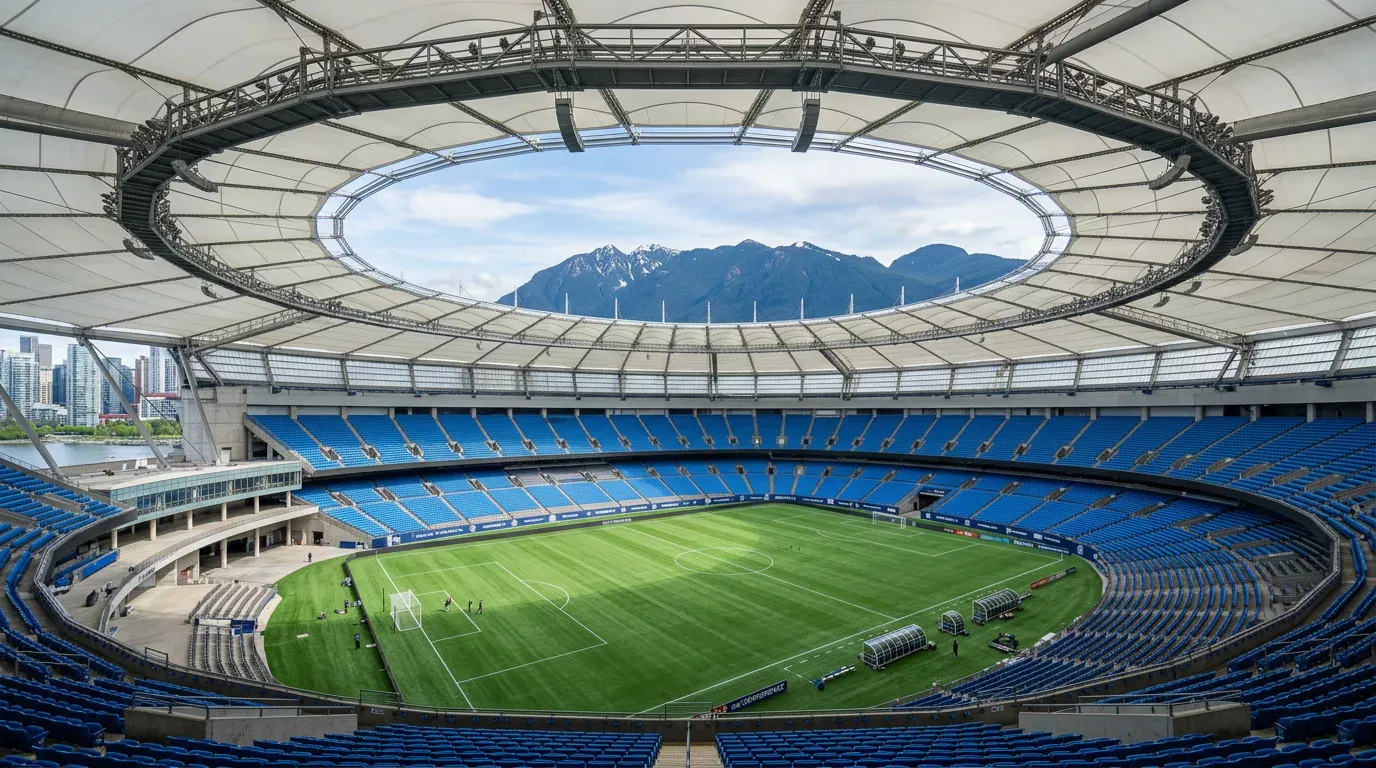
The retractable roof slides open, Pacific Northwest light floods the pitch, and 54,000 supporters see mountains framing the Vancouver skyline through the gap. I’ve watched that roof operation three times now — each time wondering whether FIFA’s pitch inspectors fully appreciate how BC Place transforms from enclosed arena to open-air stadium in 20 minutes. Vancouver’s World Cup venue offers something no American host city can match: a downtown location with natural grass, covered seating options, and the flexibility to manage whatever weather British Columbia’s June delivers. For Canadian bettors, BC Place hosts two critical CanMNT fixtures, making this venue’s characteristics essential information for World Cup wagering.
About BC Place — Retractable Roof and History
BC Place stands as the largest retractable-roof stadium in Canada, a distinction that required both engineering ambition and substantial public investment to achieve.
The original BC Place opened in 1983 as an air-supported dome — essentially a giant fabric balloon kept inflated by internal air pressure. That design served Vancouver for nearly three decades, hosting two Grey Cup championships, countless BC Lions football games, and the opening and closing ceremonies of the 2010 Winter Olympics. The air-supported roof’s limitations became apparent over time: deflation incidents during storms, inability to open the venue to natural conditions, and a dated aesthetic that corporate sponsors increasingly avoided. The 2009-2011 renovation cycle replaced the entire roof structure with a cable-supported retractable system that represents current best-practice stadium engineering.
The new roof spans 340 metres at its widest point, with fabric panels that retract toward the north end to create a 60% open configuration. The retraction process takes approximately 20 minutes and can occur in winds up to 30 km/h — though FIFA guidelines recommend completing roof operations at least two hours before kickoff to ensure stable conditions. The roof remains closed during Vancouver’s frequent rain, providing spectator protection while maintaining natural grass playing conditions through sophisticated climate control systems.
BC Place’s current capacity reaches 54,500 for soccer configurations, making it the largest venue hosting World Cup 2026 matches in Canada. The seating bowl wraps continuously around the pitch, eliminating the dead zones that plague converted baseball or American football stadiums. Lower-bowl seats sit close enough to see player expressions during corner kicks, while upper-deck positions remain within the acoustic envelope that generates genuine crowd atmosphere. The Vancouver Whitecaps FC of Major League Soccer have called BC Place home since 2011, establishing the venue’s reputation for soccer-specific atmosphere despite its multipurpose design.
The downtown Vancouver location places BC Place within the False Creek neighbourhood, surrounded by residential towers, entertainment venues, and transit connections that most World Cup stadiums cannot replicate. Supporters arriving by SkyTrain exit at Stadium-Chinatown station, emerging directly at the venue’s southeast entrance. The waterfront walking route from downtown hotels takes approximately 25 minutes, passing through the Olympic Village development that converted athletes’ housing into permanent residential community. This urban integration makes BC Place accessible in ways that suburban American stadium campuses fundamentally aren’t.
World Cup 2026 Matches at BC Place
Vancouver’s match allocation includes two Canada fixtures and one Switzerland match, making BC Place the venue where Canada’s group stage campaign reaches its decisive phase.
Canada versus Qatar on June 18 brings the CanMNT to Vancouver for the first time during World Cup 2026. The 6:00 PM ET kickoff — 3:00 PM local Pacific Time — creates an afternoon atmosphere as Vancouverites leave work early to pack the downtown streets. This Matchday 2 fixture carries significant stakes: if Canada beat Bosnia in Toronto six days earlier, victory over Qatar would secure knockout qualification before the decisive Switzerland match. The crowd of 54,000 will include supporters who flew from Toronto after the opener, creating a continental Canadian presence that BC Place has never experienced for a single match.
Switzerland versus Canada on June 24 represents the group-stage finale and potentially the match that determines Group B’s winner. The 3:00 PM ET kickoff (12:00 PM local) places this fixture in an unusual noon Pacific start — unusual for such stakes, though FIFA’s scheduling requirements mandate simultaneous final-matchday kickoffs across all groups. Swiss supporters will travel in significant numbers, but the vast majority of BC Place’s 54,000 seats will hold Canadian fans witnessing their team’s most important match in federation history. The atmosphere should rival anything seen at World Cup group stages in recent tournament memory.
Switzerland versus Qatar on June 12 opens BC Place’s World Cup hosting on the same day Canada plays Bosnia in Toronto. This 6:00 PM ET kickoff (3:00 PM local) means Vancouver’s first World Cup match occurs simultaneously with Canada’s tournament opener 4,300 kilometres east. Neutral football supporters and local Swiss-Canadian community members will fill seats, but the crowd energy will differ substantially from Canada fixtures. Swiss efficiency should produce a comfortable victory, making this match less consequential for Group B outcomes than the later Canada fixtures.
Vancouver as a World Cup Host City
Beyond the stadium itself, Vancouver’s characteristics shape match-day experiences and home advantage calculations in measurable ways.
Greater Vancouver’s population of 2.6 million places it as Canada’s third-largest metropolitan area, with demographic composition that influences supporter dynamics for various World Cup participants. The city’s Pacific Rim position has generated substantial Asian-Canadian populations — significant communities from China, India, Philippines, Korea, and Japan contribute to Vancouver’s multicultural identity. For World Cup 2026, this means fixtures involving Asian nations will draw organized supporter groups that most North American venues cannot produce. The June 12 Switzerland-Qatar match may see more organized Qatar supporters than one might expect, given Vancouver’s Middle Eastern community presence.
June weather in Vancouver averages 19°C highs with limited precipitation — the driest month in a city famous for rain. The retractable roof at BC Place provides insurance against unusual weather patterns, but most days during the tournament will feature the mild, clear conditions that make Pacific Northwest summers genuinely pleasant. Players acclimatizing from European leagues will find Vancouver’s temperatures cooler than Miami, Houston, or Dallas venues, potentially benefiting Canadian squad members who’ve spent their MLS seasons avoiding similar heat adjustments.
The three-hour time difference between Vancouver and Toronto creates viewing complications for eastern Canadian audiences. A 3:00 PM ET kickoff means noon in Vancouver — acceptable for local supporters but awkward for Pacific Time workers. Conversely, the 6:00 PM ET kickoffs translate to 3:00 PM local, placing matches in afternoon slots that Vancouver residents can attend after half-day work schedules. For bettors tracking live odds from Eastern Time zones, BC Place afternoon fixtures require calendar adjustments to avoid missing market movements.
Vancouver’s tourism infrastructure ranks among the world’s most developed, with hotel inventory that comfortably handles large international events. The 2010 Winter Olympics demonstrated Vancouver’s capacity to manage global visitor flows, and that experience informs current World Cup planning. Supporters arriving from Europe benefit from direct flights to Vancouver International Airport, while those travelling from Asia find Vancouver closer than any American host city. The accessibility advantages compound for Canada matches — fans face easier logistics reaching BC Place than navigating unfamiliar American highway systems to suburban stadium locations.
Pacific Time Considerations for Bettors
The time zone mathematics matter more than casual analysis suggests, and understanding PT scheduling reveals betting angles that eastern-focused markets might miss.
Canada’s June 18 match against Qatar kicks off at 3:00 PM local Vancouver time, meaning the match concludes around 5:00 PM PT if regulation time suffices. For eastern Canadian bettors, this 6:00 PM ET start represents prime evening viewing. But the local atmosphere differs from typical evening football — afternoon sunlight through BC Place’s open roof creates different visual conditions than artificial lighting, and crowd energy patterns follow afternoon rhythms rather than night-game intensity. These factors rarely influence outcomes, but they shape the texture of matches in ways that video review reveals.
The June 24 Switzerland-Canada fixture kicks off at noon local time — the earliest start of Canada’s three group matches. Morning supporters begin gathering in downtown Vancouver by 9:00 AM local, meaning the eastern Canadian audience (watching at 3:00 PM ET) sees a crowd that’s been building energy for hours rather than arriving just before kickoff. The noon start also means Vancouver’s substantial Asian-Canadian population — often following European time zones for business purposes — can attend without significant schedule disruption. Market liquidity for this fixture will concentrate during Eastern Time afternoon hours, with PT-based bettors potentially finding better lines during local morning windows before eastern markets fully engage.
For live betting, the PT timing creates informational asymmetries that sharp bettors can exploit. Match-day reports filed from Vancouver appear during eastern lunch hours, meaning injury updates and lineup confirmations reach markets while many eastern bettors are away from screens. The three-hour offset doesn’t change the matches themselves, but it shifts the timing of information flow in ways that reward attention to Pacific Time sources.
Betting Angles — Canada’s Western Venue
Two Canada fixtures at BC Place means this venue shapes a larger portion of CanMNT betting assessment than any other location in the tournament.
The Qatar match on June 18 carries conditional probability that depends heavily on the Bosnia result six days earlier. If Canada win in Toronto, the Qatar fixture becomes a qualification clincher with reduced pressure — a scenario that typically benefits favourites by allowing tactical flexibility. If Canada draw or lose to Bosnia, the Qatar match suddenly carries must-win stakes that change the psychological calculus entirely. Betting this fixture requires waiting until after June 12, as the market price will shift dramatically based on Toronto’s outcome.
The Switzerland match on June 24 represents the highest-leverage single fixture in Canadian football history. Both teams will likely enter with 4-6 points, meaning the winner takes first place while the loser settles for second. The noon local kickoff provides unusual conditions — neither team gains scheduling advantage, and the Pacific Northwest climate suits both squads’ European-based players. Current group winner odds show Canada at 2.50 and Switzerland at 1.95, with the head-to-head market reflecting similar dynamics. The draw at 3.40 offers value if you believe both teams will prioritize advancement security over group topping ambitions.
BC Place itself creates modest home advantage factors beyond crowd support. The retractable roof allows climate control that benefits acclimatized players — Canada’s MLS-heavy roster has played multiple matches in similar enclosed environments, while Switzerland’s entirely European-based squad may need adjustment time. The natural grass surface matches European playing conditions, minimizing the turf-related complaints that sometimes affect World Cup matches played on synthetic surfaces. These venue-specific factors add perhaps 3-5% to Canada’s probability in both fixtures, a margin that current betting prices may not fully capture.
The complete World Cup venues guide provides context on how BC Place compares to the 15 other tournament stadiums across the United States, Mexico, and Canada.
