World Cup 2026 Betting
Brazil at the 2026 World Cup — Group C Odds, Squad & Predictions
 Available in US
Loading...
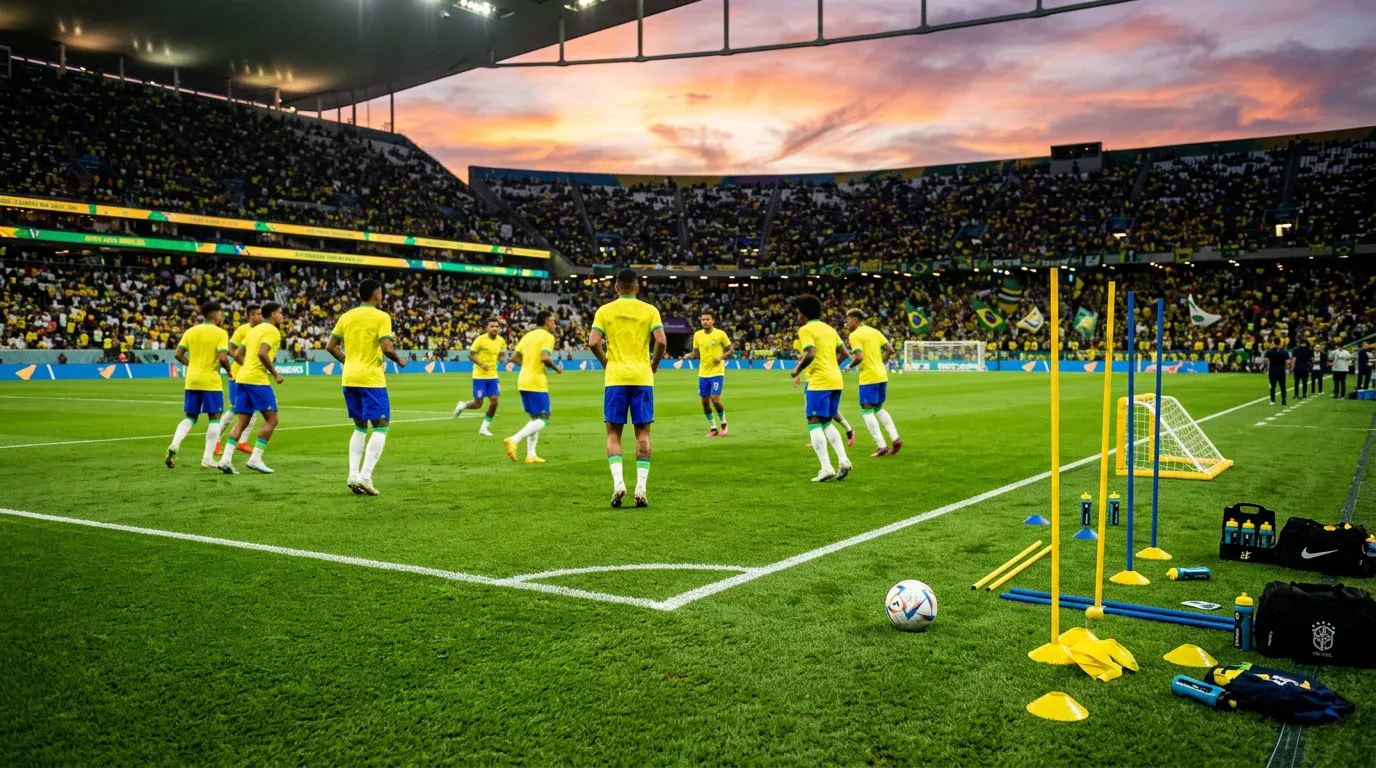
Twenty-four years without a World Cup trophy weighs on a nation that once dominated this tournament like no other. I remember watching Brazil lift the 2002 trophy in Yokohama — Ronaldo’s redemption, Rivaldo’s brilliance, Ronaldinho’s audacious free kick against England. That generation completed a record fifth world title, and every Brazilian squad since has carried the burden of restoring the Seleção to that peak. The 7-1 destruction by Germany in 2014 created a wound that still has not fully healed. The quarterfinal penalty exit to Croatia in 2022 extended the drought. Now Brazil arrives at the 2026 World Cup with renewed purpose and a squad that blends emerging talent with established stars.
Group C presents a path that should lead to advancement without significant drama. Morocco, the 2022 semifinalists, represents the genuine threat, while Haiti and Scotland fill the remaining spots without carrying realistic knockout ambitions. The betting markets position Brazil among the top three favorites to lift the trophy, alongside Argentina and France. Whether this generation can finally end the drought will determine how history judges their collective legacy — and for bettors in Canada, understanding Brazil’s genuine strengths and persistent vulnerabilities will separate profitable wagers from emotional ones influenced by the yellow shirt’s mystique.
CONMEBOL Qualification — Navigating South America’s Gauntlet
South American World Cup qualifying remains the most demanding continental pathway in football. Eighteen matches across three years against opponents who play at altitude in La Paz, humidity in Barranquilla, and the hostility of Buenos Aires produce a genuine test of squad depth and mental resilience. Brazil secured qualification comfortably, finishing in the top four of the CONMEBOL standings despite occasional turbulence that raised questions about tactical direction.
The qualifying campaign saw managerial changes that disrupted continuity. Tite’s departure after the 2022 World Cup created a transition period, and subsequent appointments brought different philosophies that the squad has gradually internalized. The current tactical setup emphasizes controlled possession and patient build-up rather than the explosive counterattacking that characterized earlier eras. Results validated the approach: victories over Argentina in one memorable encounter and consistent point accumulation against mid-table CONMEBOL opponents demonstrated organizational improvement.
Away from home, Brazil showed the resilience that separates genuine contenders from pretenders. The altitude match in Bolivia produced the expected challenges — labored breathing, heavy legs, reduced recovery times — but Brazil secured a draw that maintained their qualifying position. In Colombia, where the tropical conditions and passionate crowds in Barranquilla can overwhelm visitors, Brazil controlled possession and created enough chances to suggest tactical sophistication beyond mere talent aggregation.
The qualifying process also exposed depth concerns at specific positions. Center back partnerships rotated frequently without establishing the commanding presence that characterized Brazil’s 2002 defense. The holding midfield role remains a source of tactical debate, with different players auditioned in the Casemiro succession role. These questions will persist through the tournament, though the group stage should allow time for answers to emerge before knockout pressure arrives.
Group C — Morocco, Haiti and Scotland
The draw could have been considerably worse. Group C places Brazil alongside Morocco — the African champions and 2022 World Cup semifinalists whose defensive organization shocked Belgium, Spain, and Portugal — but also includes Haiti and Scotland, teams operating at significantly lower levels of international football. My initial reaction to the draw: Brazil should secure six points minimum from the Haiti and Scotland fixtures, making the Morocco match a battle for group positioning rather than qualification.
Morocco deserves genuine respect. Walid Regragui built a defensive system in 2022 that conceded just one goal from open play across seven matches — and that was an own goal against Canada. The Atlas Lions defend with organization, aggression, and tactical discipline that frustrated far more talented attacks. Their transition game produces dangerous counterattacks, and the diaspora support in North American stadiums will create atmosphere reminiscent of their home advantage. Brazil must approach Morocco with the same preparation they would give Argentina or France, not as a formality beneath their attention.
Haiti represents the least demanding opponent in the entire tournament draw. Their qualification through CONCACAF involved favorable circumstances and opponent weaknesses rather than dominant performances. The talent gap between Haiti’s domestic-based players and Brazil’s European stars spans multiple tiers of football quality. My concern here is purely motivational — Brazil must avoid the trap of complacency that has historically produced shocking results against minnows. The 1950 World Cup final loss to Uruguay remains cultural trauma; a group stage stumble against Haiti would create comparable ignominy.
Scotland completed Group C through European qualification but enters without the attacking firepower to threaten Brazil’s defensive structure. The Scottish style emphasizes physicality, set pieces, and organizational discipline rather than technical play that could expose Brazil’s occasional defensive lapses. John McGinn and Scott McTominay provide Premier League quality in midfield, but the overall squad depth cannot match Brazil player for player across any position. The match represents an opportunity for Brazil to experiment with tactical variations and rest key players while still securing three points.
My projected finish: Brazil tops the group with 9 points, Morocco finishes second with 6 points after defeating Haiti and Scotland while losing to Brazil, Scotland manages a single victory over Haiti to claim third, and Haiti exits without points. This outcome would set up Brazil for a Round of 32 match against a third-place finisher from Group D or Group E — opponents like Turkey, Ecuador, or a weakened Australia that should represent clear favorites scenarios.
Key Players and Squad Outlook
Vinícius Júnior carries the creative burden that previous generations distributed across multiple playmakers. His development at Real Madrid from raw speedster to complete attacking presence mirrors the evolution that turned Ronaldo and Neymar into tournament-defining players. Vinícius operates primarily from the left wing, cutting inside onto his preferred right foot to create shooting angles or threading passes into the penalty area. His pace stretches defenses horizontally, and his confidence in one-on-one situations terrifies fullbacks who know that losing the initial duel leads to dangerous situations.
The supporting cast around Vinícius has depth that exceeds most international squads. Rodrygo provides similar qualities from the right wing with perhaps slightly better finishing but less devastating dribbling. Raphinha offers energy and defensive work rate that allows tactical flexibility between formations. The wide positions represent Brazil’s clearest advantage over Group C opponents — Morocco’s fullbacks will face their sternest test of the tournament against this wing rotation.
Centrally, Richarlison leads the forward line after establishing himself during the 2022 World Cup with spectacular goals against Serbia and South Korea. His movement between central defenders creates space for wide players to exploit, and his aerial presence adds a dimension that pure technical forwards cannot provide. Behind him, the number ten role remains contested between multiple options, each bringing different strengths: creativity, physicality, defensive contribution, or experience in major finals.
The midfield base has evolved since Casemiro’s peak years. Younger players have emerged through European club football with the technical quality Brazil demands and the tactical discipline that modern pressing systems require. Bruno Guimarães brings Newcastle United’s intensity and Premier League physical preparation to the Brazil midfield, while others provide rotation options across both the six and eight positions.
Defensive concerns persist despite talented individuals. Marquinhos leads the center back pairing with Champions League experience and organizational ability, but his partners have rotated without establishing consistent combinations. The fullback positions feature attacking quality over defensive reliability — a trade-off that produces spectacular play going forward but occasional vulnerability against transition-focused opponents. This balance suits Group C opposition but may prove problematic in knockout matches against European teams who defend deep and counterattack sharply.
Alisson anchors the goalkeeping position with the shot-stopping quality and distribution that elite tournament football demands. His Premier League experience against physical forwards and aerial bombardment prepares him for the varied challenges each Group C opponent presents. The backup goalkeeper options provide adequate tournament security without raising succession concerns.
Tactical Identity Under the Current Setup
The pragmatic turn in Brazilian football philosophy represents a departure from the romantic traditions that older supporters remember. This Brazil team controls games through possession rather than pure attacking expression, building patiently from the back and waiting for defensive mistakes to exploit rather than forcing spectacular combinations through congested spaces. I find this approach sensible given the demands of tournament football — pretty football that loses in quarterfinals serves only nostalgia, not trophies.
The base formation operates as a 4-3-3 with Vinícius and Rodrygo providing width while Richarlison occupies central defenders. The midfield triangle varies between single and double pivot structures depending on opponent quality and match context. Against Morocco’s organized defense, expect the double pivot to provide stability and reduce transition vulnerability. Against Haiti and Scotland, the single pivot should allow more creative players to occupy advanced positions and produce the necessary goal surplus.
Pressing intensity has increased compared to earlier eras. The front three engage opposing center backs and goalkeepers with coordinated triggers, forcing hurried clearances and creating possession opportunities in dangerous areas. The midfield supports this pressing with aggressive positioning that reduces recovery space for opponents. Stamina management becomes important across tournament weeks — Brazil cannot maintain this intensity for seven matches across 30 days without squad rotation and careful tactical adjustments.
Set piece routines have received specific attention after the 2022 exit highlighted failures in both attacking and defensive situations. The coaching staff identified structural weaknesses and implemented new patterns that early qualifying matches suggested have improved outcomes. Against Morocco’s set piece threats — their aerial power was instrumental in the 2022 run — Brazil’s defensive organization will face its most demanding test before the knockout rounds.
Brazil’s World Cup Pedigree — Five Titles in Context
No nation has won more World Cups than Brazil. The five titles span eras from Pelé’s emergence in 1958 through Ronaldo’s redemption in 2002, covering tactical evolutions from rigid formations to total football to modern pressing systems. This history creates both inspiration and pressure — every Brazilian player understands the expectations carried with the yellow shirt, and every elimination produces national mourning that extends beyond football into cultural identity.
The 1958 triumph in Sweden introduced Pelé to the world stage as a 17-year-old whose brilliance defied comprehension. Four years later in Chile, Brazil retained the trophy with the same core augmented by Garrincha’s wing wizardry. The 1970 squad in Mexico is frequently cited as the greatest team ever assembled — Pelé, Jairzinho, Rivelino, Tostão, and Carlos Alberto producing football that transcended competition and became art. These achievements established Brazil as football’s spiritual home, the nation where the beautiful game found its purest expression.
The 1994 and 2002 victories came from different stylistic traditions. Romário’s clinical finishing propelled a pragmatic 1994 squad to success in the United States, while Ronaldo’s 2002 redemption narrative created the last chapter of Brazilian World Cup triumph. Since then: a 2006 quarterfinal exit to France, a 2010 quarterfinal loss to Netherlands, the 2014 semi-final humiliation against Germany on home soil, a 2018 quarterfinal defeat to Belgium, and the 2022 penalty shootout elimination against Croatia. Six consecutive tournaments without reaching the final. Six opportunities missed. The current generation carries the accumulated weight of these near-misses, though they also benefit from the tactical lessons each failure provided.
Historical patterns offer encouragement for 2026 odds. Brazil performs slightly better in North American settings than European venues — climate conditions, travel distances, and crowd demographics all favor South American teams playing in the Western Hemisphere. The time zone differences between North American match times and European schedules reduce the home advantage that European teams enjoy at European World Cups. These structural factors suggest Brazil’s odds undervalue their positioning for this particular tournament.
The psychological dimension cannot be ignored when assessing Brazil’s tournament prospects. The weight of expectation either elevates or crushes, depending on how individual players process pressure. Previous generations handled this burden differently — some thrived under scrutiny while others crumbled at decisive moments. The current squad includes players who have won the biggest club trophies available, which should provide resilience against tournament pressure. Vinícius Júnior has scored in Champions League finals; that experience should inoculate against World Cup knockout anxiety.
Betting Odds — Outright, Group and Player Markets
The outright market prices Brazil between 6.00 and 8.00 depending on the sportsbook, positioning them alongside Argentina and France as co-favorites to lift the trophy. These odds reflect genuine title probability rather than inflated pricing — Brazil belongs in this tier based on squad quality, historical pedigree, and favorable group positioning. For Canadian bettors seeking exposure to full tournament odds comparisons, Brazil represents the value pick among favorites if you believe the 24-year drought creates extra motivation rather than psychological burden.
Group C winner odds sit around 1.40, reflecting the significant quality gap between Brazil and Morocco while acknowledging that the Atlas Lions could spring an upset in the head-to-head match. The pricing accurately represents Brazil’s advancement probability near 90% — these are not value wagers but rather starting points for understanding market expectations.
Player markets offer more interesting opportunities. Vinícius Júnior’s Golden Boot odds around 12.00 to 15.00 provide value if you project Brazil reaching the semifinals or beyond, where goal accumulation accelerates. His primary competition comes from teammates like Rodrygo and Richarlison, and the rotation between attacking positions should not significantly reduce his minutes in meaningful matches. Rodrygo’s finishing numbers at Real Madrid suggest he could emerge as a secondary scoring threat at similar odds with less market attention.
Team total goals markets will price Brazil high — expect over 8.5 tournament goals lines that carry reasonable probability given the Group C opposition. The Haiti and Scotland matches should produce multi-goal margins if Brazil performs to expected levels, building toward goal difference advantages that matter for knockout seeding purposes.
Tournament Projection
Brazil reaches the Round of 32 with near-certainty, likely as Group C winners with maximum points or 7 points after a draw with Morocco. The bracket positioning should produce a favorable first knockout match against a third-place qualifier or group runner-up from the middle tier of opponents. A Round of 16 exit would constitute significant underperformance.
The quarterfinals represent the historical barrier that Brazil has failed to surpass since 2014. Potential opponents at that stage include teams from Groups G, H, or the survivor of a knockout bracket collision — Belgium, Spain, or Uruguay represent plausible scenarios that would test Brazil’s knockout credentials. Each of these matches would be competitive rather than overwhelming favorites situations.
Semifinal advancement depends on whether the coaching staff has solved the psychological fragility that penalty shootouts exposed in 2022. Brazil’s technical quality does not diminish in high-pressure moments, but decision-making in the final third and penalty execution have faltered when elimination loomed. The current squad includes experienced players who have won Champions League finals and Copa América knockouts — this experience should translate to improved tournament composure, though proof requires actual results rather than theoretical projections.
My assessment: Brazil has approximately 15-18% probability of winning the tournament, justifying odds around 5.50 to 6.50 for positive expected value. The market pricing around 7.00 offers marginal value for long-term holders who believe this generation can finally end the drought. The semifinal probability sits near 35%, making Brazil one of three most likely finalists alongside Argentina and France.
The path to the final runs through potential matchups that will test every aspect of Brazil’s preparation. A quarterfinal against Spain would examine possession patience — two teams comfortable holding the ball creates chess matches where the first tactical error proves costly. Against England, the physical dimension intensifies, with Premier League familiarity cutting both ways as opponents know Brazilian players’ tendencies from weekly league battles. France presents perhaps the most demanding test: comparable individual talent across positions, tournament experience in knockout pressure, and the psychological edge of recent success that Brazil currently lacks.
Fitness monitoring across the tournament will prove critical. The North American summer presents heat challenges in certain venues, though Canadian host cities offer more moderate conditions. Brazil’s squad depth allows rotation strategies that preserve key players for knockout matches — expect significant lineup changes against Haiti and potentially Scotland to manage cumulative fatigue. The coaching staff has demonstrated awareness of this requirement in recent qualifying campaigns, and tournament application should follow similar patterns.
The 2026 World Cup represents a generational opportunity for this Brazilian core. Vinícius Júnior will be 25, entering his prime years. The supporting cast will be experienced without being aged. The favorable draw positioning and bracket structure create pathways that previous generations might have envied. Whether this opportunity produces the sixth star above the Brazilian crest depends on factors that analysis can inform but not fully predict — but the foundation for success exists, and the odds reflect that reality.
Canadian supporters with Brazilian connections — and the diaspora community remains significant in Toronto and other urban centers — will find Group C matches accessible viewing times with reasonable travel distances to potential knockout venues. The tournament structure allows for live attendance at Brazil matches without prohibitive logistics, creating engagement opportunities that pure television viewing cannot replicate. These factors may influence betting behavior among engaged supporters who want financial stakes matching their emotional investment.
