
World Cup 2026 Betting
MetLife Stadium — World Cup 2026 Final Venue Guide
 Available in US
Loading...
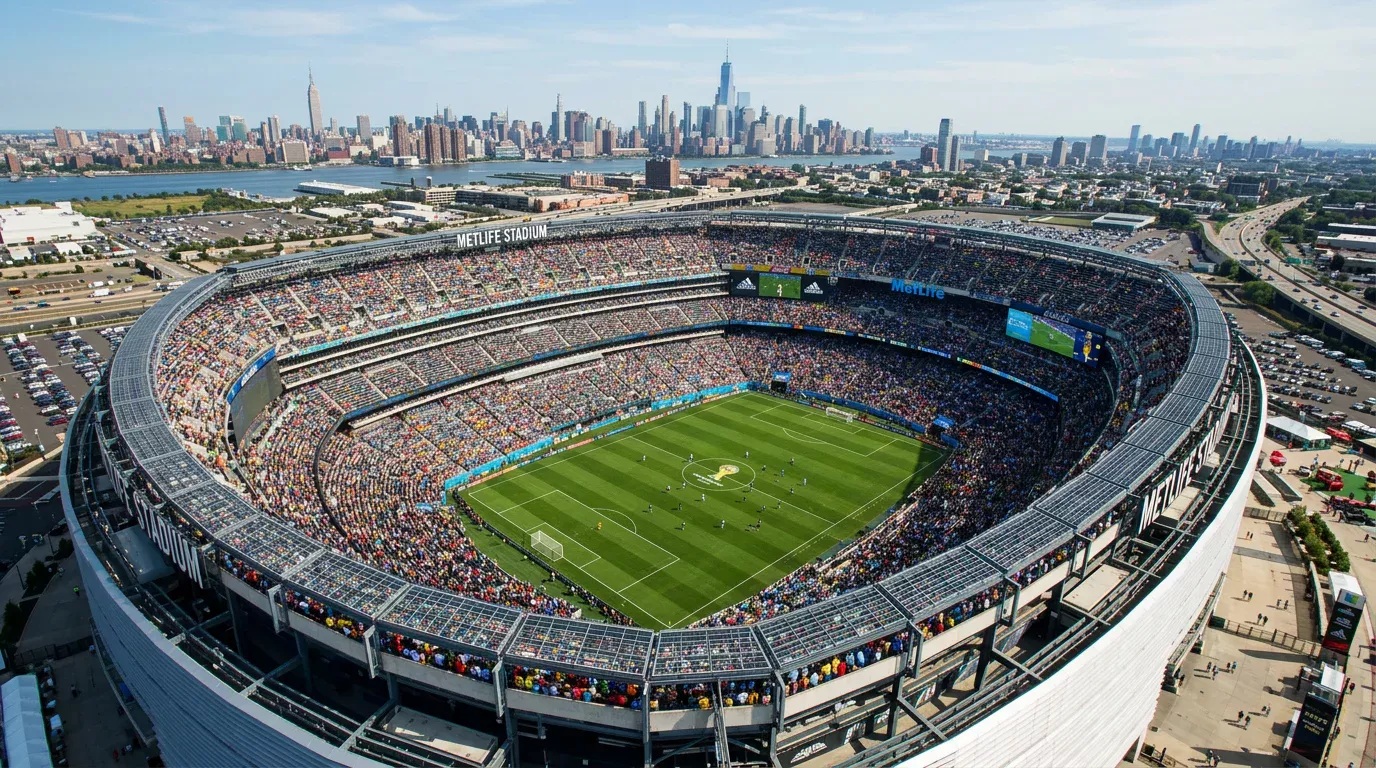
Every World Cup betting market eventually points toward one stadium, one match, one final whistle. On July 19, 2026, that moment arrives at MetLife Stadium in East Rutherford, New Jersey — a venue whose selection for the World Cup Final surprised no one who understands American football infrastructure politics. FIFA chose the New York metropolitan area’s largest stadium over options in Los Angeles, Dallas, and Miami, betting that the global financial capital’s media concentration and corporate hospitality capacity outweigh climate concerns about a July match in the northeastern United States. For bettors building outright tournament wagers, understanding MetLife Stadium’s characteristics informs the kind of final-match analysis that separates educated projections from blind speculation.
About MetLife Stadium
MetLife Stadium exists as the shared home of two NFL franchises — the New York Giants and New York Jets — a cohabitation arrangement that influences everything from scheduling flexibility to field surface conditions.
The stadium opened in 2010, replacing the adjacent Giants Stadium that had served the region since 1976. The $1.6 billion construction cost made MetLife Stadium the most expensive sports venue ever built at that time, a record since surpassed by SoFi Stadium in Los Angeles and Tottenham Hotspur Stadium in London. The design prioritizes sightlines for American football while remaining adaptable for soccer, concerts, and other mass-attendance events. The open-air configuration — no roof despite the northeastern climate — creates weather exposure that summer tournaments avoid but winter NFL games embrace.
Capacity reaches 82,500 for soccer configurations, making MetLife Stadium the largest venue at World Cup 2026. The seating bowl wraps around the pitch in continuous sections, with lower-level seats positioned closer to the playing surface than most NFL stadiums achieve. The corner sections, sometimes problematic in rectangular-sport conversions, maintain acceptable sight angles at MetLife due to steeper upper-deck rake that compensates for football’s wider field requirements. Premium seating includes 218 luxury suites and 10,000 club seats — corporate hospitality inventory that FIFA’s ticketing allocation will heavily emphasize for the final.
The natural grass playing surface at MetLife Stadium undergoes complete replacement before each major soccer event, with sod installed specifically for World Cup matches rather than maintained year-round. This approach ensures optimal playing conditions but eliminates the “home field” surface knowledge that some venues provide regular tenants. For the World Cup Final, FIFA will install grass approximately three weeks before the July 19 match date, allowing root establishment while minimizing the wear that earlier tournament fixtures might cause.
Location presents MetLife Stadium’s primary practical challenge. The venue sits in the Meadowlands Sports Complex, a development zone in East Rutherford, New Jersey — technically not in New York City despite bearing the New York branding of both NFL tenants. The 13-kilometre distance from Manhattan requires transit planning that confuses international visitors expecting urban stadium access. New Jersey Transit rail connections reach Secaucus Junction, with shuttle buses completing the stadium journey during major events. Driving from Manhattan takes 20-40 minutes depending on tunnel traffic, while Uber and taxi services face surge pricing that international supporters often underestimate.
World Cup 2026 Matches — Including the Final
FIFA allocated eight matches to MetLife Stadium, the most of any venue at World Cup 2026, culminating in the tournament’s decisive fixture.
The group stage brings six matches to MetLife Stadium across June 13-27, featuring several marquee fixtures that preview the venue’s World Cup Final atmosphere. Opening-round matches include fixtures from Groups D, I, and J, with USA-Turkey on June 22 likely drawing the largest American television audience of the group phase. The schedule ensures MetLife Stadium hosts matches every 3-4 days during the group stage, testing the grass surface’s durability and the venue’s operational systems before knockout rounds begin.
A round of 32 match on July 2 or 3 provides the first knockout-stage action at MetLife Stadium, with the specific fixture depending on group-stage outcomes. This match serves as a dress rehearsal for the final, allowing FIFA to identify operational adjustments needed before the tournament’s climax. The round of 32 allocation suggests FIFA views MetLife Stadium as their premier American venue, worthy of high-stakes knockout fixtures rather than merely group-stage inventory.
The World Cup 2026 Final on July 19 at 4:00 PM ET represents the tournament’s singular defining moment. That afternoon kickoff time balances global television requirements — midnight in Central Europe, 5:00 AM in Tokyo, 9:00 PM in London — against the venue’s open-air configuration that makes evening matches preferable to midday heat exposure. The 82,500 capacity will accommodate approximately 70,000 general supporters (after media, corporate, and FIFA allocations), with ticket prices reaching levels that price out casual attendees in favour of devoted fans willing to pay four-figure sums for finals access.
World Cup Finals — Historical Context
The World Cup Final carries atmospheric and psychological weight that distinguishes it from every other match in the tournament, and understanding that history informs betting approaches.
Since 1930, 22 World Cup Finals have produced 9 different champions across 14 host nations. The final’s unique pressure environment has consistently shaped outcomes in ways that upset regular-season form expectations. Italy’s 2006 victory over France saw Zinedine Zidane’s infamous headbutt transform a drawn match into penalty drama. Spain’s 2010 triumph required extra time to overcome Dutch defensive resistance. Germany’s 2014 demolition of Brazil in the semifinal gave way to a tense 1-0 final victory over Argentina. Argentina’s 2022 triumph over France produced arguably the greatest final in tournament history — a match that swung from 2-0 Argentina to 3-3 before penalties decided the championship.
The pattern across recent finals shows tight matches decided by margins that exceed what pre-match betting odds suggested. Since 2006, only one final (Spain’s 1-0 over Netherlands in 2010) finished in 90 minutes without requiring extra time or penalties. The under 2.5 goals line has cashed in 4 of the last 5 finals, reflecting the defensive conservatism that teams employ when championship stakes override tactical ambition. Finals betting requires adjusting for this historical pattern rather than simply projecting semi-final form forward.
American venue hosting adds novelty that historical patterns cannot fully account for. The 1994 World Cup final at the Rose Bowl in Pasadena produced a 0-0 draw decided by penalty kicks — Brazil over Italy in a match that generated more drama through spot-kicks than open play. Whether American audiences and climate conditions systematically affect final outcomes remains unknowable from a single data point, but the 1994 precedent suggests finals played in North America might trend toward defensive, low-scoring affairs that reach extra time.
Betting on the World Cup Final
The final represents the ultimate destination for outright tournament bets, and positioning for that market requires understanding how finalist pricing evolves.
Current outright winner odds show the usual suspects at market peaks: France trades around 5.50, England at 6.00, Brazil at 7.00, Argentina at 8.00, Germany at 10.00, and Spain at 12.00. These prices imply combined probability around 65% for a top-six finalist — reasonable given tournament history but hardly certain. The remaining 35% distributes across dark horses including Portugal (15.00), Netherlands (18.00), and the host nations (USA at 25.00, Canada at 65.00, Mexico at 80.00).
Finalist betting — picking a team to reach the final regardless of outcome — offers alternative market structures that reduce the variance inherent in single-match knockout outcomes. England to reach the final currently trades around 3.00, implying roughly 33% probability of surviving six knockout matches. France to reach the final sits near 2.50, reflecting their status as narrow tournament favourites. These markets require the same analysis as outright winner bets but eliminate the final-match coin-flip that historically determines champions.
Match betting for the final itself opens only after semifinal results confirm the participants. Historical finals pricing typically shows small favourites — rarely exceeding 1.80 on the moneyline — because teams reaching the final have demonstrated quality that narrows perceived gaps. The draw in regulation time has traded between 3.20 and 3.60 in recent finals, reflecting the caution that characterizes championship matches. Overtime and penalty props generate substantial handle, with the combination (match to go to extra time or penalties) typically pricing between 2.50 and 3.00 based on historical frequency.
For the 2026 final specifically, the MetLife Stadium venue and July 19 afternoon timing create conditions worth monitoring. Open-air stadiums in late July produce temperatures that can exceed 30°C, potentially affecting match tempo and favouring teams with superior squad depth. The 4:00 PM ET kickoff avoids peak heat but still places significant portions of the match in direct afternoon sunlight. Teams from traditionally cooler climates — England, Germany, Netherlands — may face disadvantages compared to South American or Southern European finalists accustomed to warmer conditions.
Getting There from New York City
Canadian bettors planning MetLife Stadium attendance face logistics questions that differ significantly from Toronto or Vancouver venue access.
The most reliable transit option combines New Jersey Transit rail from Penn Station to Secaucus Junction, followed by event shuttles that run on World Cup match days. The rail journey takes approximately 25 minutes, with shuttle connections adding 15-20 minutes depending on boarding queues. Return journeys after match conclusions can stretch significantly — post-event congestion at Secaucus Junction sometimes produces 90-minute waits for outbound shuttles, making taxi or rideshare alternatives worth considering despite the cost.
Driving from Manhattan requires either the Lincoln Tunnel or George Washington Bridge, both of which experience match-day congestion that frustrates navigation algorithms’ time estimates. The stadium’s parking lots accommodate 28,000 vehicles, with pricing that will reach premium levels for World Cup Final attendance. Most visitors staying in Manhattan hotels will find transit or hired vehicles more practical than rental car arrangements that require bridge tolls, parking fees, and post-event traffic navigation.
From Canadian border crossings, MetLife Stadium sits approximately 650 kilometres from Toronto (7 hours driving) or 550 kilometres from Montreal (6 hours). Direct flights to Newark Liberty International Airport place visitors within 15 kilometres of the stadium, making air travel followed by transit or rideshare the most practical approach for Canadian attendees. The final’s Saturday afternoon timing allows for same-day return to Eastern Canadian cities via late-evening flights, though availability for such routes will evaporate quickly once finalist matchups become known.
The complete World Cup 2026 venues guide provides context on MetLife Stadium’s positioning relative to the 15 other tournament stadiums across the United States, Canada, and Mexico.
