World Cup 2026 Betting
Spain at the 2026 World Cup — Group H Odds, Squad & Preview
 Available in US
Loading...
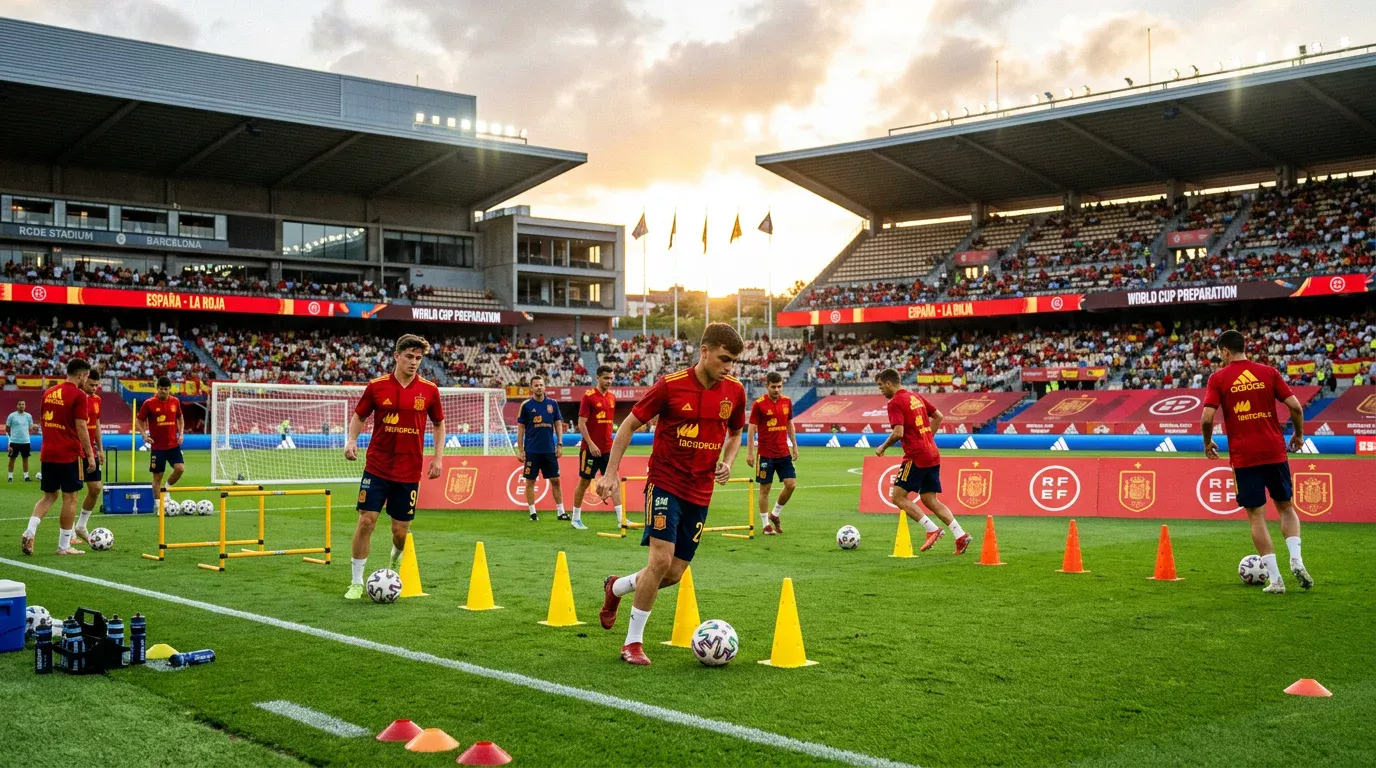
The reinvention worked. I watched Spain dismantle England in the Euro 2024 final with a tactical sophistication that honored their possession heritage while adding vertical directness the tiki-taka era sometimes lacked. Lamine Yamal, seventeen years old, creating chances against Premier League defenders with the confidence of a veteran. Nico Williams terrorizing the opposite flank. Rodri conducting everything from midfield with the authority his Manchester City performances had suggested was transferable to international football. That tournament victory announced Spain’s return to elite status after a decade of disappointing major tournaments, and the 2026 World Cup arrives with La Roja positioned among genuine favorites rather than nostalgic contenders.
Group H places Spain alongside Saudi Arabia, Uruguay, and Cape Verde — a draw that combines South American pedigree with Asian unpredictability and African tournament debutants. Uruguay represents the genuine group stage test, their historical World Cup success and current squad quality demanding respect that Saudi Arabia’s 2022 Argentina upset and Cape Verde’s qualifying achievement cannot equally claim. For Canadian bettors evaluating all qualified teams, Spain’s combination of recent success and generational talent creates attractive market positioning that reflects genuine championship probability.
UEFA Qualification
Spanish qualification through UEFA proceeded with the efficiency their talent level demands. The group stage produced dominant performances that confirmed the Euro 2024 triumph was no fluke — this squad possesses the quality and tactical understanding to control matches against any opposition. Manager Luis de la Fuente has built a system that maximizes individual brilliance while maintaining the collective organization that tournament football requires. The tactical framework established during European Championship preparation continued refining throughout qualification, with players developing the automatic movements and passing combinations that possession football demands.
The qualification campaign allowed tactical refinement and squad integration that Euro preparation time constraints had limited. Younger players received minutes that built international experience without risking qualification outcomes. By campaign’s end, the squad hierarchy had clarified, with starting positions established and rotation options tested in meaningful fixtures. The depth revealed through this process exceeds most European competitors, with backup options capable of maintaining quality when primary starters require rest.
Away fixtures across European venues demonstrated Spanish adaptability. The team secured results in difficult environments through controlled possession that opponents could not disrupt, combined with attacking transitions that the Euro 2024 triumph had validated. This dual threat — patience in possession with explosive vertical moments — defines the current Spanish identity and explains their position among tournament favorites. The hostile atmospheres encountered during qualification provided preparation for World Cup knockout intensity, where crowd pressure accompanies tactical challenges.
Defensive stability throughout qualification addressed concerns that previous Spanish generations had created. Clean sheets against organized opponents demonstrated that possession dominance now includes defensive reliability. The goal difference accumulated through qualification — heavily positive without conceding significantly — suggests a balanced team rather than attack-dependent side vulnerable to counter-punching opponents.
Group H — Saudi Arabia, Uruguay and Cape Verde
Uruguay represents the primary Group H challenge. La Celeste’s World Cup history includes two titles and consistent knockout advancement that demonstrates tournament pedigree exceeding most European opponents. The current squad combines experienced campaigners with emerging talents whose European club development has raised collective quality. Darwin Núñez’s Liverpool form and Federico Valverde’s Real Madrid brilliance anchor a team capable of competing with any group opponent.
The Spain-Uruguay fixture will determine Group H’s outcome more definitively than any other match. Both teams should defeat Saudi Arabia and Cape Verde comfortably, making their direct encounter the effective group final. Spain’s technical superiority should translate to possession dominance, but Uruguay’s counter-attacking threat and physical intensity create genuine upset potential. This match requires Spanish concentration that group stage fixtures against inferior opponents sometimes fail to produce.
Saudi Arabia shocked Argentina in their 2022 World Cup opener, a result that demonstrates the danger of underestimating opposition regardless of perceived quality gaps. The Saudi squad has developed through domestic league investment and strategic naturalization policies, though the overall talent level remains below European and South American competitors. Spain should control this fixture through possession, but complacency would invite the kind of surprise that Argentine supporters remember painfully.
Cape Verde’s qualification represents historic achievement for the island nation, their presence in Group H reflecting developmental success rather than realistic knockout ambitions. The talent gap between Cape Verde’s squad and Spanish stars spans multiple tiers of football quality. Spain should secure maximum goal difference improvement while managing minutes for key players. The primary risk involves injury against opponents whose intensity may exceed their technical control.
My projection: Spain tops the group with 9 points, Uruguay finishes second with 6 points after defeating Saudi Arabia and Cape Verde while losing to Spain, Saudi Arabia claims third with a victory over Cape Verde, and Cape Verde exits without points. This outcome positions Spain for a Round of 32 match against a third-place finisher from Group G or Group E — potentially Egypt, New Zealand, Ecuador, or Curaçao.
Squad and Key Figures
Lamine Yamal has rewritten expectations for teenage players at major tournaments. His Euro 2024 performances — becoming the youngest goalscorer in European Championship history — announced a generational talent whose development trajectory suggests prime years will produce statistics that redefine attacking positions. Yamal operates from the right wing with the dribbling ability, passing vision, and shooting accuracy that defenders cannot consistently contain. His partnership with Nico Williams on the opposite flank creates width that stretches defenses beyond recovery.
Nico Williams provides the direct running and finishing that Yamal’s creative brilliance complements. His Athletic Bilbao form translated immediately to international football, where his pace and power troubled England’s experienced defenders throughout the Euro 2024 final. Williams’ defensive work rate allows Spain to press high without exposing the right side to counter-attacks, and his crossing accuracy creates chances that central attackers convert.
Rodri anchors everything from the holding midfield position. His Ballon d’Or-winning 2024 season demonstrated the complete midfielder — defensive positioning, progressive passing, leadership presence, and occasional goals from distance that break deadlocked matches. Rodri’s injury history creates squad management concerns, but when fit, he provides the platform upon which Spanish attacking brilliance operates. Without him, Spain remains competitive; with him, they become genuine favorites.
Pedri and Gavi represent Barcelona’s contribution to the Spanish midfield pipeline. Pedri’s technical quality and positional intelligence create passing combinations that unlock organized defenses. Gavi’s energy and pressing intensity disrupt opponents’ build-up play while contributing to Spanish possession phases. The three-man midfield of Rodri, Pedri, and Gavi provides tactical flexibility — defensive solidity when required, creative dominance when opportunities arise.
The attacking focal point has evolved beyond traditional striker reliance. Álvaro Morata provides experience and aerial presence, but Spain’s goals come from multiple sources — wingers cutting inside, midfielders arriving late, fullbacks overlapping into dangerous positions. This distributed goalscoring makes Spain difficult to defend against, as shutting down single players cannot eliminate their attacking threat.
Defensive organization has improved markedly since the early 2020s struggles. Aymeric Laporte and various center-back partners have established understanding that produces clean sheets against quality opposition. The fullback positions feature technically proficient players whose attacking contributions integrate with Spanish possession patterns while maintaining positional discipline.
Style of Play — Evolution of Tiki-Taka
The tiki-taka philosophy that produced 2010 World Cup and 2008-2012 European Championship success has evolved rather than disappeared. Current Spanish football maintains possession emphasis but adds vertical directness that the original approach sometimes lacked. When opponents drop deep to deny space, Spain still circulates patiently. When transition opportunities arise, Spain attacks immediately with the pace that Yamal and Williams provide. This tactical flexibility distinguishes the current generation from predecessors whose commitment to possession sometimes became predictable.
The 4-3-3 formation creates the structural base, with positional flexibility allowing adjustments based on opponent structure and match state. The front three interchange positions fluidly, preventing defenders from establishing marking patterns that would limit Spanish creativity. Midfield rotations create numerical advantages across the pitch, with Pedri and Gavi supporting attacks while Rodri maintains defensive balance. The coordination required for this system has developed through consistent selection and tactical drilling that club commitments sometimes interrupt.
Pressing intensity has increased compared to the Xavi-Iniesta era’s more measured approach. The front line engages opponents immediately after losing possession, with midfield support maintaining pressure through coordinated movements. This aggression creates turnover opportunities in dangerous areas that quick attackers exploit. The risk involves exposure when pressing is bypassed, but defensive transition speed has improved sufficiently to manage this vulnerability. The pressing triggers and recovery patterns reflect modern tactical understanding that the original tiki-taka did not prioritize as heavily.
Set pieces receive specific attention given the aerial quality available. Spain’s height disadvantage compared to physical European opponents requires tactical compensation through movement patterns and delivery accuracy. Defensive set piece organization has been restructured after previous tournament vulnerabilities exposed weaknesses that opponents exploited repeatedly. The investment in set piece coaching reflects recognition that tournament knockout matches often hinge on dead-ball situations.
Width plays crucial tactical roles in the current Spanish approach. Yamal and Williams occupy touchlines when possession settles, stretching opposing defenses horizontally before combinations unlock vertical passing lanes. This width creates one-on-one situations that Spanish wingers generally win, producing crosses and cutbacks that varied attackers finish. The fullback contributions to attacking width provide additional options when wingers draw multiple defenders, creating overloads that organized defenses cannot neutralize.
Defensive organization has evolved to support the attacking ambitions. The back four plays higher lines that enable pressing but require sweeping coverage from the goalkeeper. The center-back pairing must manage space behind the defensive line while maintaining positioning that allows quick engagement when opponents receive between the lines. This balance demands concentration and communication that experienced international players provide more reliably than domestic league preparation alone can develop.
Spain’s World Cup Record
Spain’s World Cup history includes a single title — the 2010 triumph in South Africa that completed their international dominance alongside consecutive European Championships. That generation’s control-based football produced the tournament’s only 1-0 final, with Andrés Iniesta’s extra-time goal against Netherlands securing Spain’s place among World Cup winners. The decade since has produced disappointment: 2014 group stage exit as defending champions, 2018 Round of 16 penalty loss to Russia, 2022 Round of 16 penalty loss to Morocco.
The penalty shootout failures highlight a specific vulnerability that Spain must address. Two consecutive World Cup eliminations through shootouts suggest psychological or preparation issues that tournament football exposes. The current squad includes players with club-level shootout experience, though international pressure creates different psychological dynamics. Whether the Euro 2024 triumph — which did not require shootout survival — has resolved these concerns remains untested.
Historical patterns suggest Spain performs better at European Championships than World Cups, with continental tournament victories in 2008, 2012, and 2024 contrasting with single World Cup success. The global tournament’s different atmosphere, opponent variety, and scheduling may suit Spanish preparation less optimally than European competition. These patterns provide context without determining 2026 outcomes — the current squad has proven capable of adapting beyond historical tendencies.
Betting Odds and Markets
Spain’s outright odds between 7.00 and 10.00 position them among the top tier of favorites alongside Argentina, Brazil, and France. The pricing reflects Euro 2024 triumph, generational attacking talent, and tactical sophistication that produces consistent results against quality opposition. Whether these odds offer value depends on your assessment of World Cup-specific factors — penalty shootout vulnerability, non-European tournament performance, and physical demands across 30-day competition.
Group H winner odds around 1.40-1.50 accurately reflect Spain’s advantage over Uruguay, Saudi Arabia, and Cape Verde. The Uruguay fixture creates uncertainty that easier groups would not present, making these prices less certain than equivalent odds for Argentina or France in their respective groups. Value may exist if you believe Spain’s technical superiority will translate clearly to the head-to-head result.
Player markets offer interesting opportunities given Spain’s distributed goalscoring. Yamal’s Golden Boot odds at long prices provide value if Spain reaches the semifinals, where his goal involvement should accumulate significantly. Williams’ emergence creates similar opportunities at slightly longer odds. The absence of a dominant central striker means Spanish goals come from various sources, creating value in assists markets and team total goals over lines.
Tournament specials around Spain reaching the final trade around 3.50-4.50, reflecting the genuine championship probability their talent supports. Semifinal advancement markets offer tighter prices around 2.20-2.60 that represent baseline expectations given squad quality. These prices appear fairly valued without obvious edges in either direction, though tournament variance means actual outcomes will diverge from probability-based expectations.
Match-specific betting opportunities will emerge as the tournament approaches. The Spain-Uruguay fixture will attract significant market attention as the effective group final, with both teams entering as genuine contenders. Value may exist on over/under totals if the market underestimates the attacking quality both teams possess or overestimates the defensive discipline both can maintain under pressure.
Tournament Outlook
Spain advances from Group H as winners in my projection, entering the knockout rounds with momentum from controlled group stage performances. The Round of 32 should produce comfortable advancement against a third-place qualifier whose quality cannot match Spain across most positions. The quarterfinals represent the stage where genuine championship contention begins.
Semifinal advancement sits around 40% probability in my projections. Spain’s tactical sophistication and individual quality support deep tournament runs, while penalty shootout vulnerability and World Cup-specific history provide reasons for caution. Final appearance probability near 22-25% reflects both the quality ceiling and the competitive landscape that includes Argentina, Brazil, and France as equally credible contenders.
The championship outcome depends on whether Spain can navigate knockout matches that may extend to penalties. If elimination matches conclude in regulation or extra time, Spanish quality should prevail against most opponents. Shootout scenarios introduce variance that the historical record suggests Spain handles poorly. Bettors must weigh these factors when sizing positions — Spain represents high-quality exposure with specific risk factors that other favorites do not share.
For Canadian bettors evaluating Spain positions, the Euro 2024 triumph provides the strongest evidence of current quality. That tournament demonstrated Spain can defeat elite European opposition in knockout matches — England in the final, France in the semifinals — without requiring shootout survival. If the 2026 bracket produces similar match outcomes, Spain possesses the quality to convert opportunities into trophy contention.
The floor scenario involves Round of 16 exit through penalty shootout loss, replicating the 2018 and 2022 patterns that frustrated Spanish supporters. Uruguay could also produce group stage complications if Spanish concentration wavers against South American tactical discipline. These downside scenarios seem unlikely given current squad quality but remain possible in tournament football where single matches determine fates.
The North American setting provides Spain with neutral conditions and favorable time zones for European supporters watching broadcasts. The Spanish diaspora in American cities will provide crowd presence at certain venues, creating partial home advantage that purely neutral sites would not offer. These structural factors neither guarantee success nor prevent failure, but they remove obstacles that other tournament locations might present.
