World Cup 2026 Betting
World Cup 2026 Odds — Winner, Group & Top Scorer Betting Lines
 Available in US
Loading...
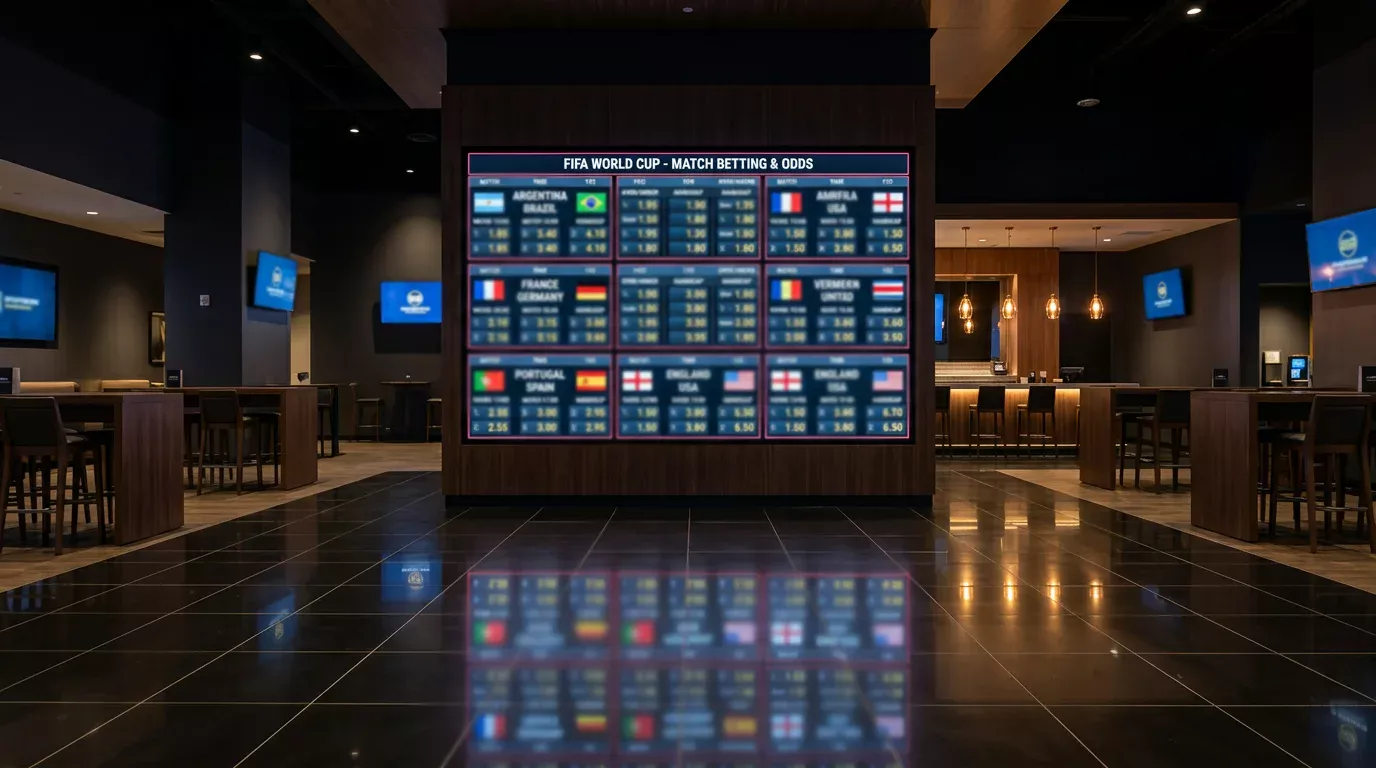
I pulled up my screen at 6:47 AM last Tuesday, coffee barely touched, and watched Argentina’s outright odds shift by 0.15 in under three minutes. No injury news, no lineup leak — just market sentiment adjusting to whispers I still haven’t tracked down. That’s the World Cup 2026 odds landscape right now: volatile, opinionated, and genuinely fascinating to navigate.
After covering tournament betting markets since 2018, I’ve learned that the months before kickoff tell you almost as much as the matches themselves. The 48-team format creates twelve groups instead of eight, which means more group winner markets, more third-place qualification scenarios, and more opportunities for sharp bettors to find edges the casual market hasn’t priced correctly. With 104 matches spread across the United States, Canada, and Mexico from June 11 to July 19, the sheer volume of World Cup 2026 odds creates both opportunity and noise.
This guide maps the entire betting landscape: outright winner markets where five or six nations are priced as genuine contenders, group winner lines that sometimes undervalue home advantage, Golden Boot futures that historically reward strikers from deep tournament runs, and Canada-specific angles that domestic bettors should understand. I’ll also walk through how odds move in the pre-tournament window, where Canadian bettors can find competitive lines, and how to read decimal versus American formats without second-guessing your math. Consider this your reference document for every odds-related question you’ll have before and during the tournament.
Outright Winner Odds — Who Will Lift the Trophy?
In March 2022, I put a small futures position on Argentina at 11.00 because their qualifying form was absurd and the market was sleeping. They won the tournament. I’m not telling you this to brag — I’m telling you because outright winner odds are where conviction matters most, and the pre-tournament window is when you lock in value that disappears once the games begin.
The current outright market for World Cup 2026 reflects a tight cluster at the top. France and England occupy the favorites tier, priced between 5.50 and 6.50 depending on the sportsbook. Both nations combine squad depth with tournament pedigree — France won in 2018 and reached the 2022 final, while England have reached consecutive European Championship finals and a World Cup semifinal in 2018. Their odds compress every time they play a strong friendly or a key player returns from injury.
Argentina, the defending champions, sit slightly behind despite holding the trophy. The market prices in age: by July 2026, Lionel Messi will be 38, Ángel Di María retired from international duty, and the spine of the 2022 squad another two years removed from their peak. Yet Argentina’s qualifying dominance — 10 wins from their first 12 CONMEBOL matches — suggests the transition has already begun successfully. At 7.00 to 8.00, Argentina represent a different proposition than the pre-2022 longshots, but the defending champion premium makes them neither obvious value nor an avoid.
Brazil’s absence from the elite tier is the market’s loudest statement. Priced around 8.50 to 9.50, the Seleção haven’t won a World Cup since 2002 and haven’t reached a final since then either. Their 2022 quarterfinal exit to Croatia extended a pattern of knockout-round disappointments, and the managerial situation has created more questions than stability. Yet Brazil’s talent pipeline never sleeps: Vinícius Jr., Rodrygo, and Endrick represent a generational attacking core. If you believe Brazil’s 20-year drought is a pricing inefficiency rather than structural decline, the 8.50+ range offers upside that France at 5.50 cannot match.
Germany and Spain occupy the 9.00 to 11.00 band, both positioned as tournament-capable nations with recent struggles. Germany’s 2022 group-stage exit followed their 2018 disaster, creating a market skepticism their Euro 2024 semifinal run hasn’t fully erased. Spain, 2010 champions with a new generation headlined by players like Lamine Yamal, are priced as dark horses rather than favorites — a curious position given their depth of midfield talent. The Spain odds particularly interest me because tournament betting historically undervalues possession-dominant sides when they click, and Spain’s Nations League performances suggest they might click in 2026.
The host nations create unique market dynamics. The United States, playing 78 of 104 matches on home soil with 11 venues, are priced around 15.00 — short enough to reflect home advantage, long enough to acknowledge they’ve never advanced past a World Cup quarterfinal. Canada and Mexico, the co-hosts, sit in the 50.00 to 100.00 range, reflecting their roles as potential dark horses rather than genuine contenders. I’ll dive deeper into Canada’s specific situation later, but the important point for outright markets is that host status historically overperforms odds in the group stage and underperforms in knockouts where quality gaps widen.
Portugal, Netherlands, and Belgium round out the serious contenders at 12.00 to 18.00. Each brings tournament experience and elite individual talent — Cristiano Ronaldo’s likely final World Cup, the Netherlands’ resurgence under a new system, Belgium’s golden generation making one last push. These odds reflect uncertainty more than ceiling: any of them could reach a semifinal without surprising anyone, but none have the market’s full confidence to go the distance.
My framework for outright betting: I want nations priced above 6.50 with a clear path to the semifinals and a roster that can handle knockout pressure. The sweet spot is often the 8.00 to 15.00 range where market skepticism creates pockets of value. At the favorites tier below 6.00, you’re paying for certainty that doesn’t exist in a 48-team tournament where a single bad match eliminates you.
Group Winner Odds — All 12 Groups
Group winner markets are where I’ve made more consistent returns than any other World Cup bet type. Why? Because casual bettors focus on outright winners and match results, leaving group winner lines with thinner volume and slower adjustment to news. A striker’s injury might shift outright odds within minutes but take hours to ripple through group markets.
The 48-team structure changes group dynamics significantly. With four teams per group instead of the previous format discussions, and twelve groups instead of eight, the number of group winner markets doubles. More markets mean more opportunities for mispricing, especially in groups featuring nations the average bettor hasn’t watched closely.
Group A features Mexico as the prohibitive favorite at 1.45 to 1.60, opening the tournament at Estadio Azteca against South Africa. South Korea, the second seed, is priced around 3.50, with Czechia at 5.00 and South Africa at 8.00 or longer. The Mexico line is fair given home advantage, but South Korea’s knockout round history — they’ve advanced from every group stage since 2010 — makes them interesting as a qualification market play rather than a group winner bet.
Group B, Canada’s group, shows Switzerland as the market favorite around 2.20, with Canada close behind at 2.50 to 2.80 depending on the book. Qatar sits around 4.50 and Bosnia and Herzegovina at 6.00 or longer. I find the Switzerland-Canada spread too wide given Canada’s home advantage — both matches in Toronto and Vancouver — but I’ll explore that fully in the Canada-specific section.
Group C presents Brazil as a 1.35 to 1.45 favorite, the shortest-priced group winner in the tournament. Morocco, 2022 semifinalists, sit around 4.00, with Scotland at 6.00 and Haiti at 15.00 or longer. The Brazil line offers no value at that price, but Morocco’s second-place odds have upside if you believe their 2022 run reflected genuine quality rather than a one-tournament anomaly.
Group D contains the United States at around 1.80 to 2.00, slightly longer than you’d expect for a host nation. Paraguay is priced at 4.00, Australia at 4.50, and Turkey at 5.00. This is one of the most competitive groups by odds distribution, with no team priced above 5.00 and the USA not dominating the market. Turkey’s presence through the UEFA playoffs creates uncertainty the market hasn’t fully resolved.
Groups E through H feature clear favorites: Germany at 1.50 in Group E, Netherlands at 1.70 in Group F, Belgium at 1.60 in Group G, and Spain at 1.40 in Group H. The Spain line is particularly compressed because Uruguay, despite their pedigree, haven’t performed at recent World Cups to the level their history suggests. I like Netherlands in Group F at 1.70 — Japan at 3.50 is the real threat, but the Dutch have handled Asian opposition comfortably in tournament settings.
Groups I through L round out the draw. France at 1.40 in Group I, Argentina at 1.35 in Group J, Portugal at 1.90 in Group K, and England at 1.55 in Group L. The Group K odds intrigue me because Colombia at 2.50 represents the best value among second-seeds in any group. Colombia’s CONMEBOL qualifying form has been excellent, and Portugal’s reliance on Cristiano Ronaldo creates lineup questions the market might be underweighting.
My approach to group winner betting: I target groups where the favorite is priced at 1.65 or longer and the second seed is priced at 3.00 or shorter. That middle ground offers the best risk-adjusted returns because you’re not paying premium for certainty, but you’re also not gambling on genuine longshots.
Top Scorer (Golden Boot) Odds
Harry Kane. Kylian Mbappé. Erling Haaland. Every casual bettor knows these names, and the sportsbooks know the casual bettors know these names. That’s why Golden Boot favorites are almost never profitable long-term plays — you’re competing against inflated odds driven by name recognition rather than goal-scoring probability.

The Golden Boot market prices individual strikers based on two factors: expected goals per match and expected matches played. A striker from a team expected to reach the final plays up to seven games, while a group-stage exit limits the sample to three. This mathematical reality creates the single most important Golden Boot insight: bet on strikers from teams likely to advance deep, not necessarily the most talented finishers.
Mbappé leads most books at 7.00 to 9.00, reflecting France’s tournament pedigree and his established scoring record — four goals in the 2022 final alone. Kane follows at 8.00 to 10.00, with England’s expected deep run compensating for his international goals-per-game rate that lags his club numbers. The Haaland line around 10.00 to 12.00 presents a curious case: Norway must advance to the knockout rounds for him to have enough matches, and their Group I assignment against France, Senegal, and Iraq makes that advancement far from certain.
The value tier sits between 15.00 and 30.00 where you find strikers from nations expected to reach at least the quarterfinals. Vinícius Jr. at 18.00 offers Brazil’s deep-run expectation without the favorite premium. Lautaro Martínez at 20.00 couples Argentina’s defending-champion status with a striker who’s already proven in tournament football. Bukayo Saka at 22.00 — if classified as a forward — brings England’s expected matches plus the goal contributions he’s shown at Euro 2024.
Historical patterns matter here. The Golden Boot winner has come from a semifinalist or finalist nation in eight of the last ten World Cups. The exceptions — James Rodríguez in 2014 (Colombia, quarterfinals) and Thomas Müller in 2010 (Germany, third place) — still came from deep-run nations. Group-stage eliminations simply don’t produce enough goals to compete.
The penalty factor adds another wrinkle. Designated penalty takers have a built-in goal advantage — Harry Kane’s England record includes a disproportionate penalty share, and Mbappé took France’s penalties throughout 2022. When evaluating Golden Boot odds, verify who takes penalties for each nation. A striker at 25.00 who takes penalties for a semifinal-bound team offers better expected value than a striker at 15.00 who doesn’t.
My Golden Boot strategy: I spread small stakes across three to five strikers in the 15.00 to 30.00 range whose teams I project to reach at least the quarterfinals. I avoid favorites below 10.00 and avoid any striker whose nation might not advance from their group.
Canada’s Odds — Group B & Beyond
When Canada’s World Cup 2026 odds first posted after the draw, I immediately checked if the market understood the home advantage situation. It didn’t — not fully. The initial lines treated Canada as a standard middle-tier nation rather than a co-host playing every group match on home soil.
Canada’s current outright winner odds hover around 75.00 to 100.00, placing them in the longshot tier alongside nations like Senegal, Morocco, and Japan. That pricing reflects both realistic ceiling assessment and the market’s memory of Canada’s 2022 World Cup — three losses, zero goals, bottom of Group F. But 2022 Canada played in Qatar without home advantage, without the tournament preparation a host nation receives, and with a squad still finding its identity under John Herdman.
The Group B odds tell a more optimistic story. Canada is priced at 2.50 to 2.80 to win the group, just behind Switzerland at 2.10 to 2.30. Qatar sits around 4.50 and Bosnia and Herzegovina at 6.00 or longer. I find this spread defensible but narrow. Switzerland are the more accomplished tournament team — quarterfinals in 2018 and 2022, consistent knockout-round presence. But Switzerland must travel to Toronto and Vancouver while Canada plays every group match at home.
The match-by-match odds breakdown reveals where value might hide. Canada opens against Bosnia and Herzegovina on June 12 at BMO Field in Toronto, priced as favorites around 1.85 to 2.00. Bosnia qualified through the UEFA playoffs by defeating Italy on penalties — a notable scalp, but also a squad without World Cup experience. Canada’s second match against Qatar on June 18 at BC Place in Vancouver shows Canada as clearer favorites around 1.65 to 1.80. Qatar’s 2022 World Cup performance as hosts — three losses, one goal — suggests their home advantage masked structural limitations. The decisive match against Switzerland on June 24, also at BC Place, prices the Swiss as slight favorites around 2.40 with Canada at 2.80 to 3.00.
To advance from Group B, Canada needs to finish in the top two or among the eight best third-place teams. The advancement odds — Canada to qualify for the Round of 32 — sit around 1.55 to 1.70, implying a 60% to 65% probability. That number feels about right given the group composition, though I’d argue the home advantage pushes the real probability closer to 70%.
The Round of 32 opponent matters significantly. Group B’s first-place finisher likely faces a third-place team from Groups E, F, or G. Second place from Group B faces the Group A winner — likely Mexico, also playing on home soil. For Canadian bettors interested in tournament-long parlays, the path through Group B looks manageable but the knockout draw introduces challenges almost immediately.
My Canada-specific approach: I see value in Canada to advance from the group at current prices. I don’t see value in Canada to win Group B unless the line drifts to 3.00 or longer. The outright winner market is too long to bet seriously — a 75.00 or 100.00 price implies you need Canada to reach at least the semifinals for your expected value to work, and that seems optimistic for a nation with one previous World Cup goal.
Value Bets & Longshot Picks
My spreadsheet from the 2022 World Cup has a tab labeled “Regrets” — positions I identified as value, wrote up the reasoning, and then didn’t pull the trigger. Morocco to reach the semifinals at 25.00 sits at the top of that list. I’m not making the same mistake twice.
Value in World Cup betting means finding implied probabilities that underestimate actual outcome likelihood. A team priced at 20.00 (5% implied probability) that you estimate at 8% actual probability represents positive expected value even if they lose four times out of five. The key is systematic identification rather than gut instinct.
Japan at 40.00 to 50.00 occupies my current value tier. They’ve reached the Round of 16 in consecutive World Cups, defeating Germany and Spain along the way in 2022. Their Group F assignment — Netherlands, Sweden, Tunisia — looks challenging but navigable. Japan’s odds reflect their historical ceiling (never past the Round of 16) rather than their current trajectory (a European-based core playing Champions League knockout football). If Japan advances from the group and draws favourably in the Round of 32, a quarterfinal isn’t outlandish.
Colombia at 30.00 to 40.00 offers similar logic. Their CONMEBOL qualifying campaign has been genuinely impressive, sitting third in the table behind Argentina and Uruguay. Group K with Portugal creates a high-profile test, but Colombia have tournament experience — 2014 quarterfinals, 2018 Round of 16 — and a balance of youth and veteran presence. The Luís Díaz-led attack combined with a disciplined defensive structure makes them dangerous in knockout settings where single moments decide matches.
Morocco at 35.00 to 45.00 carries the 2022 semifinal on its resume, which cuts both ways. The market remembers their run, so the odds have shortened from true longshot territory. But Morocco also proved their 2022 wasn’t a fluke — their squad depth, defensive organization, and Hakimi-Ziyech attacking axis remain intact. Group C with Brazil is brutal, but finishing second and advancing to face a weaker opponent from another group is realistic.

The United States at 15.00 to 18.00 represents a different kind of value — not a longshot, but potentially underpriced given circumstances. The host nation advantage in tournament football is well-documented: South Korea reached the semifinals in 2002, Russia the quarterfinals in 2018. The USA’s 2022 World Cup showed competence if not brilliance — they drew England, beat Iran, and lost to Netherlands in the Round of 16. With four years of additional development and 78 home matches, the USA could outperform a 15.00 line that implies roughly a 6% to 7% win probability.
Value betting requires discipline: small stakes spread across multiple positions, acceptance that most individual bets will lose, and patience for the math to work over repeated attempts. I’m building a portfolio approach — Japan, Colombia, Morocco, USA — rather than placing one concentrated longshot bet.
How Odds Move — Pre-Tournament Trends
Between the draw and opening day, World Cup odds shift more than most bettors realize. I’ve tracked these movements across three cycles, and the patterns are consistent enough to inform timing strategy.
Outright winner odds for favorites compress as the tournament approaches. The betting public loads up on familiar names — France, England, Argentina, Brazil — driving those lines from 7.00 or 8.00 down toward 5.00 or 6.00. If you want favorite exposure, lock it in early when the price still carries tournament-distance premium. By the week before kickoff, you’re paying retail for the same position.
Dark horse odds move in the opposite direction. Nations like Morocco, Japan, or Colombia often open with compressed lines immediately after the draw — the market overreacts to group assignments or recent form — before drifting longer as casual money flows toward favorites. I’ve seen 30.00 lines drift to 45.00 or 50.00 in the two months before a tournament. If you like a longshot, patience pays.
Injury news creates the sharpest single-day movements. When a key player — say, a starting striker or first-choice goalkeeper — picks up a training ground injury three weeks before the tournament, their nation’s odds lengthen immediately, sometimes by 10% to 15%. These corrections are often overdone, especially for deep squads with quality replacements. The market prices the name, not the tactical adjustment.
Group stage odds rarely move significantly after the draw. The matchups are known, the venues are known, and absent injury or suspension news, there’s limited new information to price. I’ve found that group winner markets in March or April offer nearly identical value to May or June prices — the inefficiencies exist immediately or not at all.
The final week before the tournament sees liquidity spike and spreads tighten. Sportsbooks know recreational bettors place most of their futures in this window, so they sharpen prices to attract volume. This is not the time to hunt for value — you’re competing against peak market efficiency. Instead, this week is for reviewing positions you’ve already established and deciding whether to add, hold, or hedge.
My timing framework: place outright favorite positions three to six months before kickoff, let longshots drift for two to three months after the draw before entering, and use the final pre-tournament week for analysis rather than action. The best prices are rarely found when everyone else is looking.
Where to Find the Best World Cup Odds in Canada
Single-event sports betting became legal across Canada in August 2021 under Bill C-218, but the regulatory landscape varies by province in ways that affect which sportsbooks you can access and what odds you’ll find. This isn’t a recommendation list — it’s a map of the terrain.
Ontario operates the most competitive market. The Alcohol and Gaming Commission of Ontario (AGCO) licenses both provincial and private operators through iGaming Ontario, creating genuine competition. Multiple sportsbooks compete for Ontario bettors, which drives odds closer to efficient market prices. When comparing outright winner lines across operators, I’ve seen spreads of 0.50 to 1.00 between the sharpest and dullest prices on the same nation. For World Cup 2026 futures, Ontario residents have the most options for line shopping.
Alberta opened to private operators in January 2026, creating a second competitive provincial market. The Alberta Gaming, Liquor and Cannabis Commission (AGLC) licenses operators under a framework similar to Ontario’s approach. Early indications suggest competitive odds, though the market is new enough that liquidity and product depth are still developing for futures markets like World Cup outright winners.
Other provinces remain limited to provincial lottery corporation products. British Columbia, Manitoba, Quebec, and the Atlantic provinces offer sports betting through government-run platforms. These platforms provide World Cup odds but without the competitive pressure that sharpens lines in Ontario or Alberta. If you live in one of these provinces and care about price optimization, the provincial option is your only regulated choice.
Line shopping matters most for outright winner and group winner markets where the price you lock represents your value ceiling for the tournament’s duration. Match odds compress to tighter spreads because volume is higher and adjustment is faster. For a Canada outright winner position, the difference between 70.00 and 85.00 is substantial — a 21% improvement in potential payout on the same outcome. That gap exists in the Ontario market; provincial monopoly markets can’t offer it.
Decimal odds remain the standard across Canadian sportsbooks, aligning with European markets. Some platforms offer American odds as an alternative display, but the underlying math is identical. If you’re more comfortable with moneyline format, every major operator lets you toggle between formats in settings. I prefer decimal because the multiplication to calculate payout is simpler: stake times odds equals total return.
The timing of account setup matters for World Cup betting. Creating accounts, verifying identity, and depositing funds all take time — anywhere from minutes to days depending on the operator and verification requirements. I recommend having accounts active and funded at least two weeks before you want to place a position. Nothing is worse than identifying value and watching it disappear while your verification is pending.
Decimal vs. American — Quick Reference
I learned to read odds on European decimal markets, so the first time I encountered American moneyline format, I spent twenty minutes with a calculator convincing myself both numbers meant the same thing. They do — the formats just express probability differently.
Decimal odds show your total return per dollar staked. If Argentina is priced at 7.00 and you wager $10, your total return on a win is $70 (your $10 stake plus $60 profit). The multiplication is straightforward: stake times decimal odds equals total return. To find profit alone, subtract your stake. To find implied probability, divide 1 by the decimal odds — 7.00 implies 14.3% probability (1 divided by 7).
American odds use positive and negative numbers relative to $100 benchmarks. A +600 favorite means you win $600 profit on a $100 stake — equivalent to 7.00 decimal. A -150 underdog means you must stake $150 to win $100 profit — equivalent to 1.67 decimal. The sign tells you whether you’re betting on a favorite (negative, more common outcome) or an underdog (positive, less common outcome).
The conversion formulas work in both directions. To convert American positive to decimal: divide by 100, add 1. So +600 becomes 6.00 plus 1, or 7.00. To convert American negative to decimal: divide 100 by the absolute value, add 1. So -150 becomes 100 divided by 150 (0.67), plus 1, or 1.67. In practice, every Canadian sportsbook lets you toggle formats with a click, so memorizing formulas is optional.
For World Cup betting, decimal format offers one practical advantage: comparing odds across multiple selections is faster. If France is 6.00, Argentina is 7.50, and Brazil is 9.00, you immediately see the relative probability ranking. American format requires more mental translation — +500, +650, +800 don’t sort as intuitively.
My recommendation: use whichever format feels natural to you, but understand both well enough to read odds on any platform. Some US-based sports content will quote American lines, and you don’t want to misinterpret a +2500 longshot as something other than a 3.8% implied probability play.
The Odds Are Just the Starting Point
World Cup 2026 odds represent the market’s collective judgment on 48 nations, hundreds of players, and 104 matches — but that judgment isn’t static, isn’t always correct, and isn’t the final word on value. The prices you see today will shift before kickoff in June, and they’ll move again after every group stage match reshapes the knockout picture.
What I’ve outlined here is a framework for reading those prices critically. The outright market clusters France, England, and Argentina as favourites, but the 8.00 to 15.00 tier is where tournament variance creates opportunity. Group winner odds reward early identification of home advantage or squad depth the market underweights. Golden Boot futures favour strikers from deep-run nations, not necessarily the most talented finishers. And Canada’s specific situation — home matches, manageable group, realistic Round of 32 path — deserves closer attention than the longshot odds might suggest.
Use this guide as a reference document throughout the pre-tournament window. Check back as lines move, as injury news breaks, as friendly results add data points. The complete betting guide covers strategy and bet types in more depth. For now, the odds are posted. The question is what you’ll do with them.
